Note: Project Gutenberg also has an HTML version of this
file which includes the original illustrations.
See 44975-h.htm or 44975-h.zip:
(http://www.gutenberg.org/files/44975/44975-h/44975-h.htm)
or
(http://www.gutenberg.org/files/44975/44975-h.zip)
Transcriber's note:
Text enclosed by underscores is in italics (_italics_).
Text enclosed by plus signs is in bold face (+bold+).
[Illustration: AUGUSTUS.
Bust in the Museum of Fine Arts. Boston.]
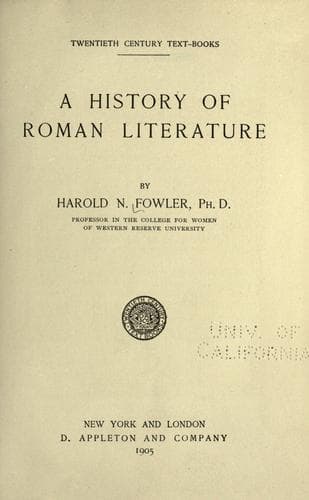
Twentieth Century Text-Books
A HISTORY OF ROMAN LITERATURE
by
HAROLD N. FOWLER, PH. D.
Professor in the College for Women of Western Reserve University
New York and London D. Appleton and Company
Copyright, 1903
By D. Appleton and Company
Printed at the Appleton Press,
New York, U. S. A.
PREFACE
This book is intended primarily for use as a text-book in schools and
colleges. I have therefore given more dates and more details about the
lives of authors than are in themselves important, because dates are
convenient aids to memory, as they enable the learner to connect his
new knowledge with historical facts he may have learned before, while
biographical details help to endow authors with something of concrete
personality, to which the learner can attach what he learns of their
literary and intellectual activity.
Extracts from Latin authors are given, with few exceptions, in English
translation. I considered the advisability of giving them in Latin, but
concluded that extracts in Latin would probably not be read by most
young readers, and would therefore do less good than even imperfect
translations. Moreover, the texts of the most important works are
sure to be at hand in the schools, and books of selections, such as
Cruttwell and Banton’s _Specimens of Roman Literature_, Tyrrell’s
_Anthology of Latin Poetry_, and Gudeman’s _Latin Literature of the
Empire_, are readily accessible. I am responsible for all translations
not accredited to some other translator. In making my translations,
I have employed blank verse to represent Latin hexameters; but the
selections from the _Æneid_ are given in Conington’s rhymed version,
and in some other cases I have used translations of hexameters into
metres other than blank verse.
In writing of the origin of Roman comedy, I have not mentioned the
dramatic _satura_. Prof. George L. Hendrickson has pointed out (in the
_American Journal of Philology_, vol. xv, pp. 1-30) that the dramatic
_satura_ never really existed, but was invented in Roman literary
history because Aristotle, whose account of the origin of comedy was
closely followed by the Roman writers, found the origin of Greek comedy
in the satyr-drama.
Public-domain text, read in full here on John Shaqi.
Reviews
Reviews
No reviews yet
Be the first to share your thoughts on this work.
Join the Discussion
Join the discussion
Sign in to leave a comment or review.
Sign InorCreate an account