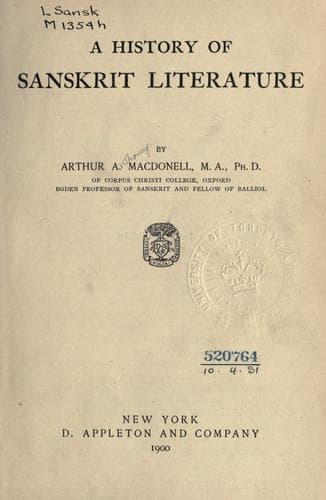
A History of Sanskrit LiteratureMacdonell, Arthur Anthony
History
A History of Sanskrit Literature
Macdonell, Arthur Anthony
Sanskrit literature -- History and criticism
Even the original portion of the White Yajurveda must have assumed
shape somewhat later than any of the recensions of the Black. For the
systematic and orderly distribution of matter by which the mantras
are collected in the Samhita, while their dogmatic explanation is
entirely relegated to a Brahmana, can hardly be as old as the confused
arrangement in which both parts are largely mixed up.
The two most important portions of the Yajurvedas deal with the new and
full moon sacrifices, as well as the soma sacrifice, on the one hand,
and with the construction of the fire-altar on the other. Chapters
1-10 of the White Yajurveda contain the mantras for the former,
chapters 11-18 those for the latter part of the ceremonial. The
corresponding ritual explanations are to be found in books 1-5 and 6-9
respectively of the Çatapatha Brahmana. In these fundamental portions
even the Black Yajurveda does not intermingle the mantras with their
explanations. The first book of the Taittiriya Samhita contains in
its first four lessons nothing but the verses and formulas to be
recited at the fortnightly and the soma sacrifices; the fourth book,
nothing but those employed in the fire-altar ritual. These books follow
the same order as, and in fact furnish a parallel recension of, the
corresponding parts of the Vajasaneyi Samhita. On the other hand, the
Taittiriya Samhita contains within itself, but in a different part,
the two corresponding Brahmanas, which, on the whole, are free from
admixture with mantras. The fifth book is the Brahmana of the fire
ritual, and the sixth is that of the soma sacrifice; but the dogmatic
explanation of the new and full moon sacrifice is altogether omitted
here, being found in the third book of the Taittiriya Brahmana. In
the Maitrayani Samhita the distribution of the corresponding material
is similar. The first three lessons of the first book contain the
mantras only for the fortnightly and the soma sacrifices; the latter
half of the second book (lessons 7-13), the mantras only for the fire
ritual. The corresponding Brahmanas begin with the sixth and the first
lesson respectively of the third book. It is only in the additions to
these fundamental parts of the Black Yajurveda that the separation of
Mantra and Brahmana is not carried out. The main difference, then,
between the Black and the White consists in the former combining
within the same collection Brahmana as well as Mantra matter. As to
its chief and fundamental parts, there is no reason to suppose that
these two kinds of matter, which are kept separate and unmixed, are
either chronologically or essentially more nearly related than are
the Vajasaneyi Samhita and the Çatapatha Brahmana.
Public-domain text, read in full here on John Shaqi.
Reviews
Reviews
No reviews yet
Be the first to share your thoughts on this work.
Elsewhere in the archive
Join the Discussion
Join the discussion
Sign in to leave a comment or review.
Sign InorCreate an account