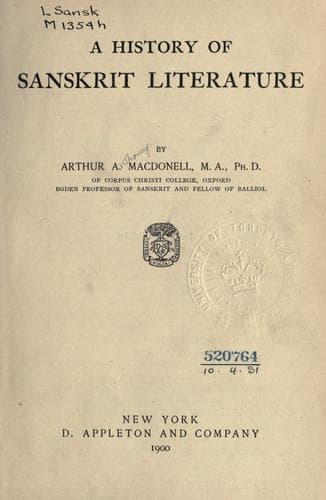
A History of Sanskrit LiteratureMacdonell, Arthur Anthony
History
A History of Sanskrit Literature
Macdonell, Arthur Anthony
Sanskrit literature -- History and criticism
The Yajurveda resembles the Samaveda in having been compiled for
application to sacrificial rites only. But while the Samaveda deals
solely with one part of the ritual, the soma sacrifice, the Yajurveda
supplies the formulas for the whole sacrificial ceremonial. Like
the Samaveda, it is also connected with the Rigveda; but while the
former is practically altogether extracted from the Rigveda, the
Yajurveda, though borrowing many of its verses from the same source,
is largely an original production. Thus somewhat more than one-fourth
only of the Vajasaneyi Samhita is derived from the Rigveda, One half
of this collection consists of verses (rich) most of which (upwards
of 700) are found in the Rigveda; the other half is made up of prose
formulas (yajus). The latter, as well as the verses not borrowed from
the Rigveda, are the independent creation of the composers of the
Yajurveda. This partial originality was indeed a necessary result of
the growth of entirely new ceremonies and the extraordinary development
of ritual detail. It became impossible to obtain from the Rigveda
even approximately suitable verses for these novel requirements.
The language of the Mantra portion of the Yajurveda, though distinctly
representing a later stage, yet on the whole agrees with that of
the Rigveda, while separated from that of classical Sanskrit by a
considerable interval.
On its mythological side the religion of the Yajurveda does not
differ essentially from that of the older Veda; for the pantheon is
still the same. Some important modifications in detail are, however,
apparent. The figure of Prajapati, only foreshadowed in the latest
hymns of the Rigveda, comes more and more into the foreground as
the chief of the gods. The Rudra of the Rigveda has begun to appear
on the scene as Çiva, being several times mentioned by that name as
well as by other epithets later peculiar to Çiva, such as Çankara and
Mahadeva. Vishnu now occupies a somewhat more prominent position than
in the Rigveda. A new feature is his constant identification with
the sacrifice. The demons, now regularly called Asuras, perpetually
appear as a group of evil beings opposed to the good gods. Their
conflicts with the latter play a considerable part in the myths of the
Yajurveda. The Apsarases, who, as a class of celestial nymphs endowed
with all the seductive charms of female beauty, occupy so important a
place in post-Vedic mythology, but are very rarely mentioned in the
Rigveda, begin to be more prominent in the Yajurveda, in which many
of them are referred to by individual names.
Public-domain text, read in full here on John Shaqi.
Reviews
Reviews
No reviews yet
Be the first to share your thoughts on this work.
Elsewhere in the archive
Join the Discussion
Join the discussion
Sign in to leave a comment or review.
Sign InorCreate an account