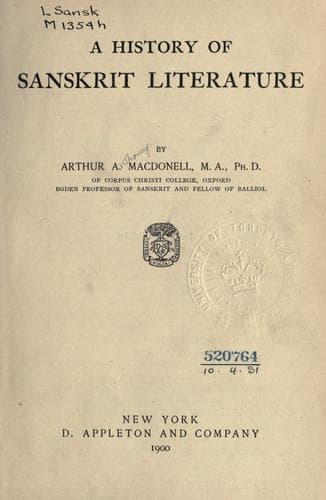
A History of Sanskrit LiteratureMacdonell, Arthur Anthony
History
A History of Sanskrit Literature
Macdonell, Arthur Anthony
Sanskrit literature -- History and criticism
Certain religious conceptions have, moreover, been modified and
new rites introduced. Thus the word brahma, which in the Rigveda
meant simply "devotion," has come to signify the essence of
prayer and holiness, an advance towards its ultimate sense in the
Upanishads. Again, snake-worship, which is unknown to the Rigveda,
now appears as an element in Indian religion. That, however, which
impresses on the Yajurveda the stamp of a new epoch is the character
of the worship which it represents. The relative importance of
the gods and of the sacrifice in the older religion has now become
inverted. In the Rigveda the object of devotion was the gods, for the
power of bestowing benefits on mankind was believed to lie in their
hands alone, while the sacrifice was only a means of influencing their
will in favour of the offerer. In the Yajurveda the sacrifice itself
has become the centre of thought and desire, its correct performance
in every detail being all-important. Its power is now so great that
it not merely influences, but compels the gods to do the will of
the officiating priest. By means of it the Brahmans may, in fact,
be said to hold the gods in their hands.
The religion of the Yajurveda may be described as a kind of mechanical
sacerdotalism. A crowd of priests conducts a vast and complicated
system of external ceremonies, to which symbolical significance is
attributed, and to the smallest minutiæ of which the greatest weight
is attached. In this stifling atmosphere of perpetual sacrifice and
ritual, the truly religious spirit of the Rigveda could not possibly
survive. Adoration of the power and beneficence of the gods, as well
as the consciousness of guilt, is entirely lacking, every prayer
being coupled with some particular rite and aiming solely at securing
material advantages. As a natural result, the formulas of the Yajurveda
are full of dreary repetitions or variations of the same idea, and
abound with half or wholly unintelligible interjections, particularly
the syllable om. The following quotation from the Maitrayani Samhita
is a good example: Nidhayo va nidhayo va om va om va om va e ai om
svarnajyotih. Here only the last word, which means "golden light,"
is translatable.
Public-domain text, read in full here on John Shaqi.
Reviews
Reviews
No reviews yet
Be the first to share your thoughts on this work.
Elsewhere in the archive
Join the Discussion
Join the discussion
Sign in to leave a comment or review.
Sign InorCreate an account