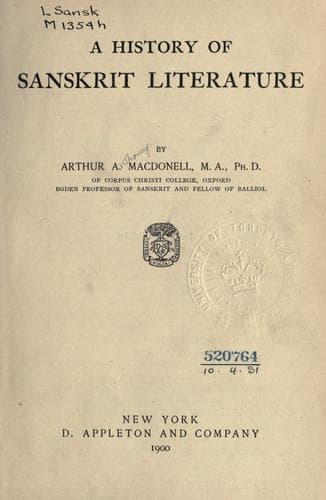
A History of Sanskrit LiteratureMacdonell, Arthur Anthony
History
A History of Sanskrit Literature
Macdonell, Arthur Anthony
Sanskrit literature -- History and criticism
The oldest name of this Veda is Atharvangirasah, a designation
occurring in the text of the Atharva-veda, and found at the beginning
of its MSS. themselves. This word is a compound formed of the names of
two ancient families of priests, the Atharvans and Angirases. In the
opinion of Professor Bloomfield the former term is here synonymous
with "holy charms," as referring to auspicious practices, while the
latter is an equivalent of "witchcraft charms." The term atharvan
and its derivatives, though representing only its benevolent side,
would thus have come to designate the fourth Veda as a whole. In its
plural form (atharvanah) the word in this sense is found several times
in the Brahmanas, but in the singular it seems first to occur in an
Upanishad. The adjective atharvana, first found as a neuter plural with
the sense of "Atharvan hymns" in the Atharva-veda itself (Book XIX.),
is common from that time onwards. The name atharva-veda first appears
in Sutras about as early as rigveda and similar designations of the
other Samhitas. There are besides two other names of the Atharva-veda,
the use of which is practically limited to the ritual texts of this
Veda. In one of these, Bhrigu-angirasah, the name of another ancient
family of fire-priests, the Bhrigus, takes the place of that of the
Angirases. The other, brahma-veda, has outside the Atharvan literature
only been found once, and that in a Grihya Sutra of the Rigveda.
A considerable time elapsed before the Atharva-veda, owing to
the general character of its contents, attained to the rank of a
canonical book. There is no evidence that even at the latest period
of the Rigveda the charms constituting the Atharva-veda were formally
recognised as a separate literary category. For the Purusha hymn, while
mentioning the three sacrificial Vedas by the names of Rik, Saman,
and Yajus, makes no reference to the spells of the Atharva-veda. Yet
the Rigveda, though it is mainly concerned with praises of the gods in
connection with the sacrifice, contains hymns showing that sorcery was
bound up with domestic practices from the earliest times in India. The
only reference to the spells of the Atharva-veda as a class in the
Yajurvedas is found in the Taittiriya Samhita, where they are alluded
to under the name of angirasah by the side of Rik, Saman, and Yajus,
which it elsewhere mentions alone. Yet the formulas of the Yajur-veda
are often pervaded by the spirit of the Atharva-veda, and are sometimes
Atharvan even in their wording. In fact, the difference between the
Rigveda and Yajurveda on the one hand, and the Atharva on the other,
as regards sorcery, lies solely in the degree of its applicability
and prominence.
Public-domain text, read in full here on John Shaqi.
Reviews
Reviews
No reviews yet
Be the first to share your thoughts on this work.
Elsewhere in the archive
Join the Discussion
Join the discussion
Sign in to leave a comment or review.
Sign InorCreate an account