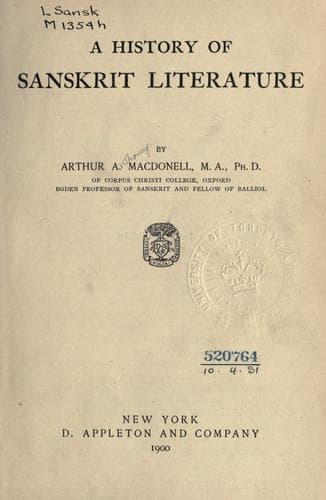
A History of Sanskrit LiteratureMacdonell, Arthur Anthony
History
A History of Sanskrit Literature
Macdonell, Arthur Anthony
Sanskrit literature -- History and criticism
The Atharva-veda itself only once mentions its own literary type
directly (as atharvangirasah) and once indirectly (as bheshaja or
"auspicious spells"), by the side of the other three Vedas, while
the latter in a considerable number of passages are referred to
alone. This shows that as yet there was no feeling of antagonism
between the adherents of this Veda and those of the older ones.
Turning to the Brahmanas, we find that those of the Rigveda do
not mention the Atharva-veda at all, while the Taittiriya Brahmana
(like the Taittiriya Aranyaka) refers to it twice. In the Çatapatha
Brahmana it appears more frequently, occupying a more defined position,
though not that of a Veda. This work very often mentions the three
old Vedas alone, either explicitly as Rik, Saman, Yajus, or as trayi
vidya, "the threefold knowledge." In several passages they are also
mentioned along with other literary types, such as itihasa (story),
purana (ancient legend), gatha (song), sutra, and upanishad. In these
enumerations the Atharva-veda regularly occupies the fourth place,
coming immediately after the three Vedas, while the rest follow in
varying order. The Upanishads in general treat the Atharva-veda in the
same way; the Upanishads of the Atharva itself, however, sometimes
tacitly add its name after the three Vedas, even without mentioning
other literary types. With regard to the Çrauta or sacrificial Sutras,
we find no reference to the Atharva in those of Katyayana (White
Yajurveda) or Latyayana (Samaveda), and only one each in those of
Çankhayana and Açvalayana (Rigveda).
Public-domain text, read in full here on John Shaqi.
Reviews
Reviews
No reviews yet
Be the first to share your thoughts on this work.
Elsewhere in the archive
Join the Discussion
Join the discussion
Sign in to leave a comment or review.
Sign InorCreate an account