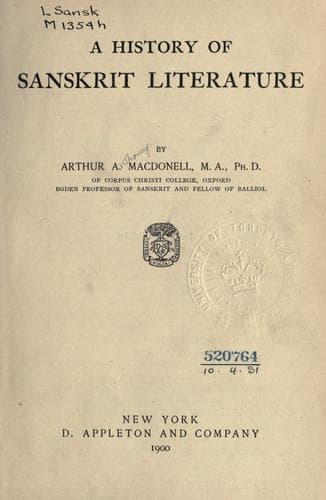
A History of Sanskrit LiteratureMacdonell, Arthur Anthony
History
A History of Sanskrit Literature
Macdonell, Arthur Anthony
Sanskrit literature -- History and criticism
In the sphere, too, of law (dharma), as dealing with popular usage and
custom, the practices of the Atharva maintained a certain place; for
the indispensable sciences of medicine and astrology were distinctively
Atharvan, and the king's domestic chaplain (purohita), believed capable
of rendering great services in the injury and overthrow of enemies by
sorcery, seems usually to have been an Atharvan priest. At the same
time it is only natural that we should first meet with censures of
the practices of the Atharva in the legal literature, because such
practices were thought to enable one man to harm another. The verdict
of the law treatises on the whole is, that as incantations of various
kinds are injurious, the Atharva-veda is inferior and its practices
impure. This inferiority is directly expressed in the Dharma Sutra
of Apastamba; and the later legal treatise (smriti) of Vishnu classes
the reciter of a deadly incantation from the Atharva among the seven
kinds of assassins. Physicians and astrologers are pronounced impure;
practices with roots are prohibited; sorceries and imprecations
are punished with severe penances. In certain cases, however,
the Atharva-veda is stated to be useful. Thus the Lawbook of Manu
recommends it as the natural weapon of the Brahman against his enemies.
In the Mahabharata we find the importance and the canonical character
of the Atharva fully recognised. The four Vedas are often mentioned,
the gods Brahma and Vishnu being in several passages described as
having created them. The Atharva is here often also referred to
alone, and spoken of with approbation. Its practices are well known
and seldom criticised adversely, magic and sorcery being, as a rule,
regarded as good.
Finally, the Puranas not only regularly speak of the fourfold Veda,
but assign to the Atharva the advanced position claimed for it by its
own ritual literature. Thus the Vishnu Purana connects the Atharva
with the fourth priest (the brahman) of the sacrificial ritual.
Public-domain text, read in full here on John Shaqi.
Reviews
Reviews
No reviews yet
Be the first to share your thoughts on this work.
Elsewhere in the archive
Join the Discussion
Join the discussion
Sign in to leave a comment or review.
Sign InorCreate an account