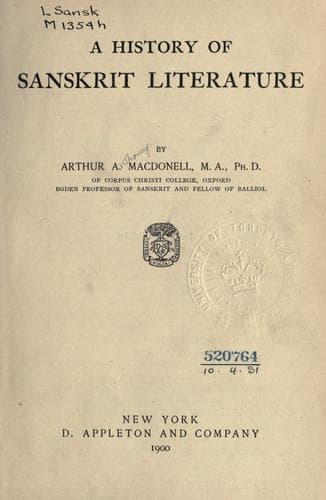
A History of Sanskrit LiteratureMacdonell, Arthur Anthony
History
A History of Sanskrit Literature
Macdonell, Arthur Anthony
Sanskrit literature -- History and criticism
Nevertheless a certain prejudice has prevailed against the Atharva from
the time of the Dharma Sutras. This appears from the fact that, even at
the present day, according to Burnell, the most influential Brahmans
of Southern India still refuse to accept the authority of the fourth
Veda, and deny its genuineness. A similar conclusion may be drawn
from occasional statements in classical texts, and especially from
the efforts of the later Atharvan writings themselves to vindicate the
character of their Veda. These ritual texts not only never enumerate
the Vedas without including the Atharva, but even sometimes place
it at the head of the four Vedas. Under a sense of the exclusion of
their Veda from the sphere of the sacrificial ritual, they lay claim
to the fourth priest (the brahman), who in the Vedic religion was
not attached to any of the three Vedas, but being required to have a
knowledge of all three and of their sacrificial application, acted as
superintendent or director of the sacrificial ceremonial. Ingeniously
availing themselves of the fact that he was unconnected with any of
the three Vedas, they put forward the claim of the fourth Veda as the
special sphere of the fourth priest. That priest, moreover, was the
most important as possessing a universal knowledge of religious lore
(brahma), the comprehensive esoteric understanding of the nature
of the gods and of the mystery of the sacrifice. Hence the Gopatha
Brahmana exalts the Atharva as the highest religious lore (brahma),
and calls it the Brahmaveda. The claim to the latter designation
was doubtless helped by the word brahma often occurring in the
Atharva-veda itself with the sense of "charm," and by the fact that
the Veda contains a larger amount of theosophic matter (brahmavidya)
than any other Samhita. The texts belonging to the other Vedas never
suggest that the Atharva is the sphere of the fourth priest, some
Brahmana passages expressly declaring that any one equipped with the
requisite knowledge maybe a brahman. The ritual texts of the Atharva
further energetically urged that the Purohita, or domestic chaplain,
should be a follower of the Atharva-veda. They appear to have finally
succeeded in their claim to this office, doubtless because kings
attached great value to a special knowledge of witchcraft.
The geographical data contained in the Atharva are but few, and
furnish no certain evidence as to the region in which its hymns were
composed. One hymn of its older portion (v. 22) makes mention of the
Gandharis, Mujavats, Mahavrishas, and Balhikas (in the north-west),
and the Magadhas and Angas (in the east); but they are referred to
in such a way that no safe conclusions can be drawn as to the country
in which the composer of the hymn in question lived.
Public-domain text, read in full here on John Shaqi.
Reviews
Reviews
No reviews yet
Be the first to share your thoughts on this work.
Elsewhere in the archive
Join the Discussion
Join the discussion
Sign in to leave a comment or review.
Sign InorCreate an account