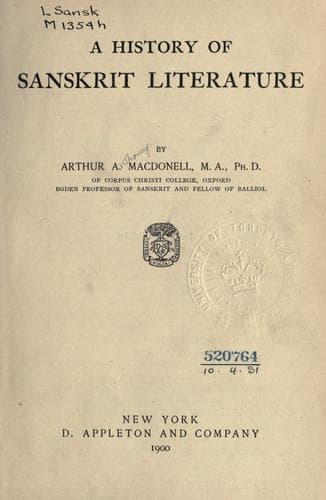
A History of Sanskrit LiteratureMacdonell, Arthur Anthony
History
A History of Sanskrit Literature
Macdonell, Arthur Anthony
Sanskrit literature -- History and criticism
These Brahmanas contain very few geographical data. From the way,
however, in which the Aitareya mentions the Indian tribes, it may be
safely inferred that this work had its origin in the country of the
Kuru-Panchalas, in which, as we have seen, the Vedic ritual must have
been developed, and the hymns of the Rigveda were probably collected
in the existing Samhita. From the Kaushitaki we learn that the study
of language was specially cultivated in the north of India, and that
students who returned from there were regarded as authorities on
linguistic questions.
The chief human interest of these Brahmanas lies in the numerous myths
and legends which they contain. The longest and most remarkable of
those found in the Aitareya is the story of Çunahçepa (Dog's-Tail),
which forms the third chapter of Book VII. The childless King
Hariçchandra vowed, if he should have a son, to sacrifice him to
Varuna. But when his son Rohita was born, he kept putting off the
fulfilment of his promise. At length, when the boy was grown up, his
father, pressed by Varuna, prepared to perform the sacrifice. Rohita,
however, escaped to the forest, where he wandered for six years,
while his father was afflicted with dropsy by Varuna. At last he
fell in with a starving Brahman, who consented to sell to him for a
hundred cows his son Çunahçepa as a substitute. Varuna agreed, saying,
"A Brahman is worth more than a Kshatriya." Çunahçepa was accordingly
bound to the stake, and the sacrifice was about to proceed, when the
victim prayed to various gods in succession. As he repeated one verse
after the other, the fetters of Varuna began to fall off and the
dropsical swelling of the king to diminish, till finally Çunahçepa
was released and Hariçchandra was restored to health again.
The style of the prose in which the Aitareya is composed is crude,
clumsy, abrupt, and elliptical. The following quotation from the
stanzas interspersed in the story of Çunahçepa may serve as a specimen
of the gathas found in the Brahmanas. These verses are addressed by
a sage named Narada to King Hariçchandra on the importance of having
a son:--
In him a father pays a debt
And reaches immortality,
When he beholds the countenance
Of a son born to him alive.
Than all the joy which living things
In waters feel, in earth and fire,
The happiness that in his son
A father feels is greater far.
At all times fathers by a son
Much darkness, too, have passed beyond:
In him the father's self is born,
He wafts him to the other shore.
Food is man's life and clothes afford protection,
Gold gives him beauty, marriages bring cattle;
His wife's a friend, his daughter causes pity:
A son is like a light in highest heaven.
Public-domain text, read in full here on John Shaqi.
Reviews
Reviews
No reviews yet
Be the first to share your thoughts on this work.
Elsewhere in the archive
Join the Discussion
Join the discussion
Sign in to leave a comment or review.
Sign InorCreate an account