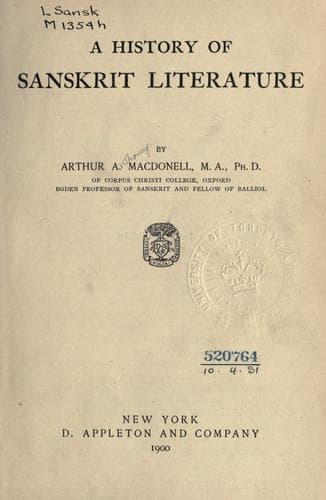
A History of Sanskrit LiteratureMacdonell, Arthur Anthony
History
A History of Sanskrit Literature
Macdonell, Arthur Anthony
Sanskrit literature -- History and criticism
To the Aitareya Brahmana belongs the Aitareya Aranyaka. It consists
of eighteen chapters, distributed unequally among five books. The
last two books are composed in the Sutra style, and are really to
be regarded as belonging to the Sutra literature. Four parts can
be clearly distinguished in the first three books. Book I. deals
with various liturgies of the Soma sacrifice from a purely ritual
point of view. The first three chapters of Book II., on the other
hand, are theosophical in character, containing speculations about
the world-soul under the names of Prana and Purusha. It is allied in
matter to the Upanishads, some of its more valuable thoughts recurring,
occasionally even word for word, in the Kaushitaki Upanishad. The
third part consists of the remaining four sections of Book II.,
which form the regular Aitareya Upanishad. Finally, Book III. deals
with the mystic and allegorical meaning of the three principal modes
in which the Veda is recited in the Samhita, Pada and Krama Pathas,
and of the various letters of the alphabet.
To the Kaushitaki Brahmana is attached the Kaushitaki Aranyaka. It
consists of fifteen chapters. The first two of these correspond to
Books I. and V. of the Aitareya Aranyaka, the seventh and eighth
to Book III., while the intervening four chapters (3-6) form the
Kaushitaki Upanishad. The latter is a long and very interesting
Upanishad. It seems not improbably to have been added as an independent
treatise to the completed Aranyaka, as it is not always found in the
same part of the latter work in the manuscripts.
Brahmanas belonging to two independent schools of the Samaveda
have been preserved, those of the Tandins and of the Talavakaras
or Jaiminiyas. Though several other works here claim the title of
ritual text-books, only three are in reality Brahmanas. The Brahmana
of the Talavakaras, which for the most part is still unpublished,
seems to consist of five books. The first three (unpublished) are
mainly concerned with various parts of the sacrificial ceremonial. The
fourth book, called the Upanishad Brahmana (probably "the Brahmana of
mystic meanings"), besides all kinds of allegories of the Aranyaka
order, two lists of teachers, a section about the origin of the
vital airs (prana) and about the savitri stanza, contains the brief
but important Kena Upanishad. Book V., entitled Arsheya-Brahmana,
is a short enumeration of the composers of the Samaveda.
Public-domain text, read in full here on John Shaqi.
Reviews
Reviews
No reviews yet
Be the first to share your thoughts on this work.
Elsewhere in the archive
Join the Discussion
Join the discussion
Sign in to leave a comment or review.
Sign InorCreate an account