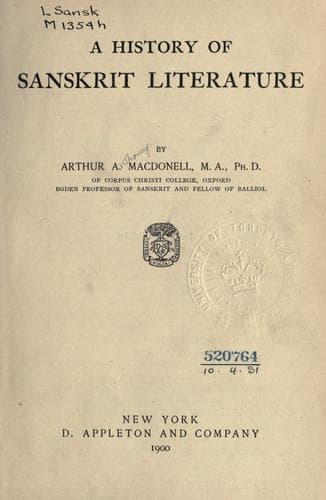
A History of Sanskrit LiteratureMacdonell, Arthur Anthony
History
A History of Sanskrit Literature
Macdonell, Arthur Anthony
Sanskrit literature -- History and criticism
The ritual explanation of the White Yajurveda is to be found in
extraordinary fulness in the Çatapatha Brahmana., the "Brahmana of the
Hundred Paths," so called because it consists of one hundred lectures
(adhyaya). This work is, next to the Rigveda, the most important
production in the whole range of Vedic literature. Its text has come
down in two recensions, those of the Madhyamdina school, edited by
Professor Weber, and of the Kanva school, which is in process of being
edited by Professor Eggeling. The Madhyamdina recension consists of
fourteen books, while the Kanva has seventeen. The first nine of the
former, corresponding to the original eighteen books of the Vajasaneyi
Samhita, doubtless form the oldest part. The fact that Book XII. is
called madhyama, or "middle one," shows that the last five books
(or possibly only X.-XIII.) were at one time regarded as a separate
part of the Brahmana. Book X. treats of the mystery of the fire-altar
(agnirahasya), XI. is a sort of recapitulation of the preceding ritual,
while XII. and XIII. deal with various supplementary matters. The
last book forms the Aranyaka, the six concluding chapters of which
are the Brihadaranyaka Upanishad.
Books VI.-X. of the Çatapatha Brahmana occupy a peculiar
position. Treating of the construction of the fire-altar, they
recognise the teaching of Çandilya as their highest authority,
Yajnavalkya not even being mentioned; while the peoples who are
named, the Gandharas, Salvas, Kekayas, belong to the north-west. In
the other books Yajnavalkya is the highest authority, while hardly
any but Eastern peoples, or those of the middle of Hindustan, the
Kuru-Panchalas, Kosalas, Videhas, Srinjayas, are named. That the
original authorship of the five Çandilya books was different from that
of the others is indicated by a number of linguistic differences,
which the hand of a later editor failed to remove. Thus the use of
the perfect as a narrative tense is unknown to the Çandilya books
(as well as to XIII.).
Public-domain text, read in full here on John Shaqi.
Reviews
Reviews
No reviews yet
Be the first to share your thoughts on this work.
Elsewhere in the archive
Join the Discussion
Join the discussion
Sign in to leave a comment or review.
Sign InorCreate an account