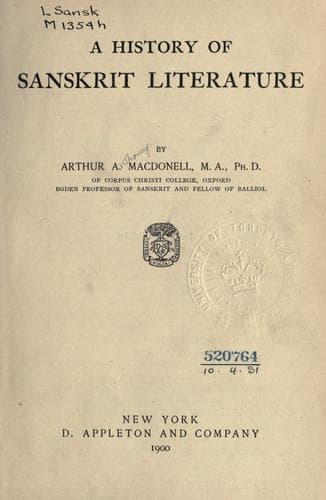
A History of Sanskrit LiteratureMacdonell, Arthur Anthony
History
A History of Sanskrit Literature
Macdonell, Arthur Anthony
Sanskrit literature -- History and criticism
In the Black Yajurveda the prose portions of the various Samhitas form
the only Brahmanas in the Katha and the Maitrayaniya schools. In
the Taittiriya school they form the oldest and most important
Brahmana. Here we have also the Taittiriya Brahmana as an independent
work in three books. This, however, hardly differs in character
from the Taittiriya Samhita, being rather a continuation. It forms a
supplement concerned with a few sacrifices omitted in the Samhita,
or handles, with greater fulness of detail, matters already dealt
with. There is also a Taittiriya Aranyaka, which in its turn forms
a supplement to the Brahmana. The last four of its ten sections
constitute the two Upanishads of this school, vii.-ix. forming the
Taittiriya Upanishad, and x. the Maha-Narayana Upanishad, also called
the Yajniki Upanishad. Excepting these four sections, the title of
Brahmana or Aranyaka does not indicate a difference of content as
compared with the Samhita, but is due to late and artificial imitation
of the other Vedas.
The last three sections of Book III. of the Brahmana, as well as the
first two books of the Aranyaka, originally belonged to the school
of the Kathas, though they have not been preserved as part of the
tradition of that school. The different origin of these parts is
indicated by the absence of the change of y and v to iy and uv
respectively, which otherwise prevails in the Taittiriya Brahmana
and Aranyaka. In one of these Kathaka sections (Taitt. Br. iii. 11),
by way of illustrating the significance of the particular fire called
nachiketa, the story is told of a boy, Nachiketas, who, on visiting
the House of Death, was granted the fulfilment of three wishes by
the god of the dead. On this story is based the Kathaka Upanishad.
Though the Maitrayani Samhita has no independent Brahmana, its fourth
book, as consisting of explanations and supplements to the first
three, is a kind of special Brahmana. Connected with this Samhita,
and in the manuscripts sometimes forming its second or its fifth book,
is the Maitrayana (also called Maitrayaniya and Maitri) Upanishad.
Public-domain text, read in full here on John Shaqi.
Reviews
Reviews
No reviews yet
Be the first to share your thoughts on this work.
Elsewhere in the archive
Join the Discussion
Join the discussion
Sign in to leave a comment or review.
Sign InorCreate an account