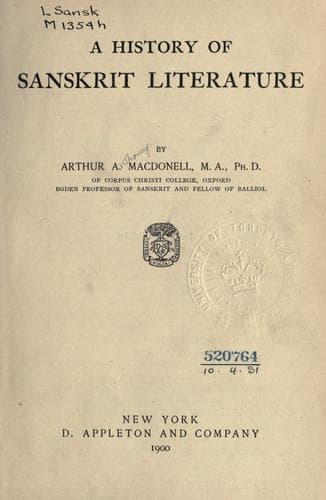
A History of Sanskrit LiteratureMacdonell, Arthur Anthony
History
A History of Sanskrit Literature
Macdonell, Arthur Anthony
Sanskrit literature -- History and criticism
As Buddhism first obtained a firm footing in Kosala and Videha, it is
interesting to inquire in what relation the Çatapatha Brahmana stands
to the beginnings of that doctrine. In this connection it is to be
noted that the words Arhat, Çramana, and Pratibuddha occur here for
the first time, but as yet without the technical sense which they have
in Buddhistic literature. Again, in the lists of teachers given in
the Brahmana mention is made with special frequency of the Gautamas,
a family name used by the Çakyas of Kapilavastu, among whom Buddha
was born. Certain allusions are also suggestive of the beginnings of
the Sankhya doctrine; for mention is several times made of a teacher
called Asuri, and according to tradition Asuri is the name of a leading
authority for the Sankhya system. If we inquire as to how far the
legends of our Brahmana contain the germs of the later epic tales,
we find that there is indeed some slight connection. Janamejaya,
the celebrated king of the Kurus in the Mahabharata, is mentioned
here for the first time. The Pandus, however, who proved victorious
in the epic war, are not to be met with in this any more than in the
other Brahmanas; and Arjuna, the name of their chief, is still an
appellation of Indra. But as the epic Arjuna is a son of Indra, his
origin is doubtless to be traced to this epithet of Indra. Janaka,
the famous king of Videha, is in all probability identical with the
father of Sita, the heroine of the Ramayana.
Of two legends which furnished the classical poet Kalidasa with the
plots of two of his most famous dramas, one is told in detail, and the
other is at least alluded to. The story of the love and separation
of Pururavas and Urvaçi, already dimly shadowed forth in a hymn of
the Rigveda, is here related with much more fulness; while Bharata,
son of Duhshanta and of the nymph Çakuntala, also appears on the
scene in this Brahmana.
A most interesting legend which reappears in the Mahabharata, that
of the Deluge, is here told for the first time in Indian literature,
though it seems to be alluded to in the Atharva-veda, while it is
known even to the Avesta. This myth is generally regarded as derived
from a Semitic source. It tells how Manu once came into possession of
a small fish, which asked him to rear it, and promised to save him
from the coming flood. Having built a ship in accordance with the
fish's advice, he entered it when the deluge arose, and was finally
guided to the Northern Mountain by the fish, to whose horn he had
tied his ship. Manu subsequently became the progenitor of mankind
through his daughter.
Public-domain text, read in full here on John Shaqi.
Reviews
Reviews
No reviews yet
Be the first to share your thoughts on this work.
Elsewhere in the archive
Join the Discussion
Join the discussion
Sign in to leave a comment or review.
Sign InorCreate an account