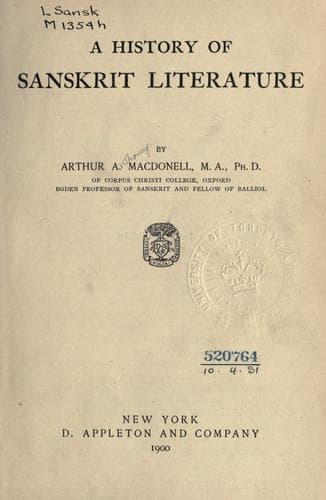
A History of Sanskrit LiteratureMacdonell, Arthur Anthony
History
A History of Sanskrit Literature
Macdonell, Arthur Anthony
Sanskrit literature -- History and criticism
The Çatapatha Brahmana is thus a mine of important data and noteworthy
narratives. Internal evidence shows it to belong to a late period
of the Brahmana age. Its style, as compared with the earlier works
of the same class, displays some progress towards facility and
clearness. Its treatment of the sacrificial ceremonial, which is
essentially the same in the Brahmana portions of the Black Yajurveda,
is throughout more lucid and systematic. On the theosophic side, too,
we find the idea of the unity in the universe more fully developed
than in any other Brahmana work, while its Upanishad is the finest
product of Vedic philosophy.
To the Atharva-veda is attached the Gopatha Brahmana, though it has
no particular connection with that Samhita. This Brahmana consists of
two books, the first containing five chapters, the second six. Both
parts are very late, for they were composed after the Vaitana Sutra and
practically without any Atharvan tradition. The matter of the former
half, while not corresponding or following the order of the sacrifice
in any ritual text, is to a considerable extent original, the rest
being borrowed from Books XI. and XII. of the Çatapatha Brahmana,
besides a few passages from the Aitareya. The main motive of this
portion is the glorification of the Atharva-veda and of the fourth or
brahman priest. The mention of the god Çiva points to its belonging to
the post-Vedic rather than to the Brahmana period. Its presupposing the
Atharva-veda in twenty books, and containing grammatical matters of a
very advanced type, are other signs of lateness. The latter half bears
more the stamp of a regular Brahmana, being a fairly connected account
of the ritual in the sacrificial order of the Vaitana Çrauta Sutra;
but it is for the most part a compilation. The ordinary historical
relation of Brahmana and Sutra is here reversed, the second book of
the Gopatha Brahmana being based on the Vaitana Sutra, which stands
to it practically in the relation of a Samhita. About two-thirds of
its matter have already been shown to be taken from older texts. The
Aitareya and Kaushitaki Brahmanas have been chiefly exploited, and to
a less extent the Maitrayani and Taittiriya Samhitas. A few passages
are derived from the Çatapatha, and even the Panchavimça Brahmana.
Though the Upanishads generally form a part of the Brahmanas, being
a continuation of their speculative side (jnana-kanda), they really
represent a new religion, which is in virtual opposition to the
ritual or practical side (karma-kanda). Their aim is no longer the
obtainment of earthly happiness and afterwards bliss in the abode of
Yama by sacrificing correctly to the gods, but release from mundane
existence by the absorption of the individual soul in the world-soul
through correct knowledge. Here, therefore, the sacrificial ceremonial
has become useless and speculative knowledge all-important.
Public-domain text, read in full here on John Shaqi.
Reviews
Reviews
No reviews yet
Be the first to share your thoughts on this work.
Elsewhere in the archive
Join the Discussion
Join the discussion
Sign in to leave a comment or review.
Sign InorCreate an account