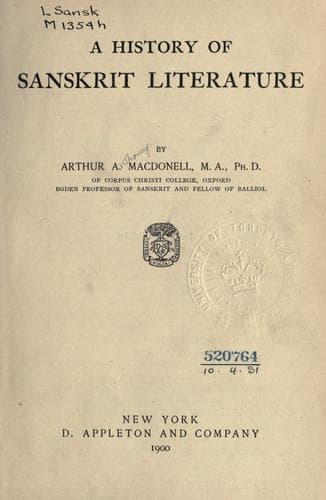
A History of Sanskrit LiteratureMacdonell, Arthur Anthony
History
A History of Sanskrit Literature
Macdonell, Arthur Anthony
Sanskrit literature -- History and criticism
Finally, one of the most interesting subjects with which the Grihya
Sutras deal is that of funeral rites (antyeshti) and the worship
of the Manes. All but children under two years of age are to be
cremated. The dead man's hair and beard are cut off and his nails
trimmed, the body being anointed with nard and a wreath being placed
on the head. Before being burnt the corpse is laid on a black antelope
skin. In the case of a Kshatriya, his bow (in that of a Brahman his
staff, of a Vaiçya his goad) is taken from his hand, broken, and cast
on the pyre, while a cow or a goat is burnt with the corpse. Afterwards
a purifying ablution is performed by all relations to the seventh
or tenth degree. They then sit down on a grassy spot and listen to
old stories or a sermon on the transitoriness of life till the stars
appear. At last, without looking round, they return in procession to
their homes, where various observances are gone through. A death is
followed by a period of impurity, generally lasting three days, during
which the relatives are required, among other things, to sleep on the
ground and refrain from eating flesh. On the night after the death
a cake is offered to the deceased, and a libation of water is poured
out; a vessel with milk and water is also placed in the open air, and
the dead man is called upon to bathe in it. Generally after the tenth
day the bones are collected and placed in an urn, which is buried to
the accompaniment of the Rigvedic verse, "Approach thy mother earth"
(x. 18, 10).
The soul is supposed to remain separated from the Manes for a time as a
preta or "ghost." A çraddha, or "offering given with faith" (çraddha),
of which it is the special object (ekoddishta), is presented to it in
this state, the idea being that it would otherwise return and disquiet
the relatives. Before the expiry of a year he is admitted to the
circle of the Manes by a rite which makes him their sapinda ("united
by the funeral cake"). After the lapse of a year or more another
elaborate ceremony (called pitri-medha) takes place in connection
with the erection of a monument, when the bones are taken out of the
urn and buried in a suitable place. There are further various general
offerings to the Manes, or çraddhas, which take place at fixed periods,
such as that on the day of new moon (parvana çraddha), while others
are only occasional and optional. These rites still play an important
part in India, well-to-do families in Bengal spending not less than
5000 to 6000 rupees on their first çraddha.
From all these offerings of the Grihya ritual are to be distinguished
the two regular sacrifices of the Çrauta ritual, the one called
Pinda-pitri-yajna immediately preceding the new-moon sacrifice, the
other being connected with the third of the four-monthly sacrifices.
Public-domain text, read in full here on John Shaqi.
Reviews
Reviews
No reviews yet
Be the first to share your thoughts on this work.
Elsewhere in the archive
Join the Discussion
Join the discussion
Sign in to leave a comment or review.
Sign InorCreate an account