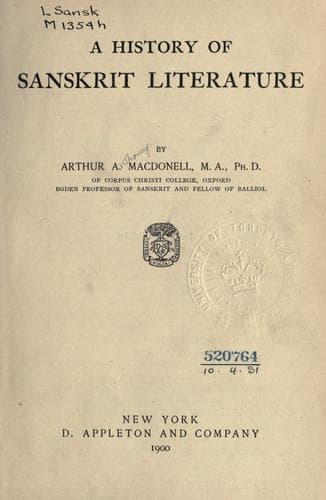
A History of Sanskrit LiteratureMacdonell, Arthur Anthony
History
A History of Sanskrit Literature
Macdonell, Arthur Anthony
Sanskrit literature -- History and criticism
The ceremonial of ancestor-worship was especially elaborated, and
developed a special literature of its own, extending from the Vedic
period to the legal Compendia of the Middle Ages. The Çraddha-kalpa
of Hemadri comprises upwards of 1700 pages in the edition of the
Bibliotheca Indica.
The above is the briefest possible sketch of the abundant material
of the Grihya Sutras, illustrating the daily domestic life of ancient
India. Perhaps, however, enough has been said to show that they have
much human interest, and that they occupy an important place in the
history of civilisation.
The second branch of the Sutra literature, based on tradition or
Smriti, are the Dharma Sutras, which deal with the customs of everyday
life (samayacharika). They are the earliest Indian works on law,
treating fully of its religious, but only partially and briefly of
its secular, aspect. The term Dharma Sutra is, strictly speaking,
applied to those collections of legal aphorisms which form part
of the body of Sutras belonging to a particular branch (çakha) of
the Veda. In this sense only three have been preserved, all of them
attached to the Taittiriya division of the Black Yajurveda. But there
is good reason to suppose that other works of the same kind which
have been preserved, or are known to have existed, were originally
also attached to individual Vedic schools. That Sutras on Dharma were
composed at a very early period is shown by the fact that Yaska, who
dates from near the beginning of the Sutra age, quotes legal rules
in the Sutra style. Indeed, one or two of those extant must go back
to about his time.
The Dharma Sutra which has been best preserved, and has remained free
from the influence of sectarians or modern editors, is that of the
Apastambas. It forms two (28-29) of the thirty sections of the great
Apastamba Kalpa Sutra, or body of aphorisms concerning the performance
of sacrifices and the duties of the three upper classes. It deals
chiefly with the duties of the Vedic student and of the householder,
with forbidden food, purifications, and penances, while, on the
secular side, it touches upon the law of marriage, inheritance, and
crime only. From the disapprobation which the author expresses for a
certain practice of the people of the North, it may be inferred that he
belonged to the South, where his school is known to have been settled
in later times. Owing to the pre-Paninean character of its language and
other criteria, Bühler has assigned this Dharma Sutra to about 400 B.C.
Public-domain text, read in full here on John Shaqi.
Reviews
Reviews
No reviews yet
Be the first to share your thoughts on this work.
Elsewhere in the archive
Join the Discussion
Join the discussion
Sign in to leave a comment or review.
Sign InorCreate an account