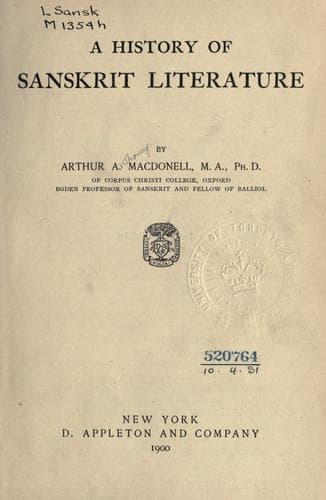
A History of Sanskrit LiteratureMacdonell, Arthur Anthony
History
A History of Sanskrit Literature
Macdonell, Arthur Anthony
Sanskrit literature -- History and criticism
Fragments of a legal treatise in prose and verse, attributed to the
brothers Çankha and Likhita, who became proverbial for justice, have
been similarly preserved. This work, which must have been extensive,
and dealt with all branches of law, is already quoted as authoritative
by Paraçara. The statement of Kumarila (700 A.D.) that it was connected
with the Vajasaneyin school of the White Yajurveda is borne out by
the quotations from it which have survived.
Sutras need not necessarily go back to the oldest period of Indian
law, as this style of composition was never entirely superseded by
the use of metre. Thus there is a Vaikhanasa dharma-sutra in four
praçnas, which, as internal evidence shows, cannot be earlier than
the third century A.D. It refers to the cult of Narayana (Vishnu),
and mentions Wednesday by the name of budha-vara, "day of Mercury." It
is not a regular Dharma Sutra, for it contains nothing connected
with law in the strict sense, but is only a treatise on domestic law
(grihya-dharma). It deals with the religious duties of the four orders
(açramas), especially with those of the forest hermit. For it is
with the latter order that the Vaikhanasas, or followers of Vikhanas,
are specially connected. They seem to have been one of the youngest
offshoots of the Taittiriya school.
Looking back on the vast mass of ritual and usage regulated by the
Sutras, we are tempted to conclude that it was entirely the conscious
work of an idle priesthood, invented to enslave and maintain in
spiritual servitude the minds of the Hindu people. But the progress
of research tends to show that the basis even of the sacerdotal ritual
of the Brahmans was popular religious observances. Otherwise it would
be hard to understand how Brahmanism acquired and retained such a
hold on the population of India. The originality of the Brahmans
consisted in elaborating and systematising observances which they
already found in existence. This they certainly succeeded in doing
to an extent unknown elsewhere.
Public-domain text, read in full here on John Shaqi.
Reviews
Reviews
No reviews yet
Be the first to share your thoughts on this work.
Elsewhere in the archive
Join the Discussion
Join the discussion
Sign in to leave a comment or review.
Sign InorCreate an account