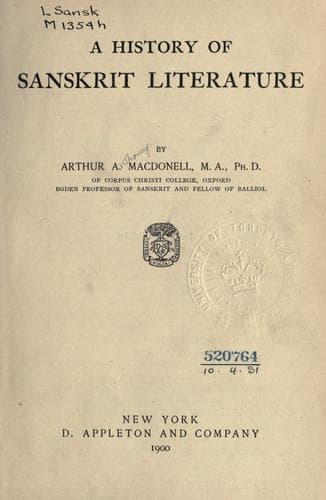
A History of Sanskrit LiteratureMacdonell, Arthur Anthony
History
A History of Sanskrit Literature
Macdonell, Arthur Anthony
Sanskrit literature -- History and criticism
Comparative studies have shown that many ritual practices go back to
the period when the Indians and Persians were still one people. Thus
the sacrifice was even then the centre of a developed ceremonial, and
was tended by a priestly class. Many terms of the Vedic ritual already
existed then, especially soma, which was pressed, purified through a
sieve, mixed with milk, and offered as the main libation. Investiture
with a sacred cord was, as we have seen, also known, and was in its
turn based on the still older ceremony of the initiation of youths
on entering manhood. The offering of gifts to the gods in fire is
Indo-European, as is shown by the agreement of the Greeks, Romans,
and Indians. Indo-European also is that part of the marriage ritual
in which the newly wedded couple walk round the nuptial fire, the
bridegroom presenting a burnt offering and the bride an offering
of grain; for among the Romans also the young pair walked round
the altar from left to right before offering bread (far) in the
fire. Indo-European, too, must be the practice of scattering rice
or grain (as a symbol of fertility) over the bride and bridegroom,
as prescribed in the Sutras; for it is widely diffused among peoples
who cannot have borrowed it. Still older is the Indian ceremony
of producing the sacrificial fire by the friction of two pieces
of wood. Similarly the practice in the construction of the Indian
fire-altar of walling up in the lowest layer of bricks the heads
of five different victims, including that of a man, goes back to an
ancient belief that a building can only be firmly erected when a man
or an animal is buried with its foundations.
Finally, we have as a division of the Sutras, concerned with religious
practice, the Çulva Sutras. The thirtieth and last praçna of the
great Kalpa Sutra of Apastamba is a treatise of this class. These
are practical manuals giving the measurements necessary for the
construction of the vedi, of the altars, and so forth. They show
quite an advanced knowledge of geometry, and constitute the oldest
Indian mathematical works.
The whole body of Vedic works composed in the Sutra style, is according
to the Indian traditional view, divided into six classes called
Vedangas ("members of the Veda"). These are çiksha or phonetics;
chhandas, or metre; vyakarana, or grammar; nirukta, or etymology;
kalpa, or religious practice; and jyotisha, or astronomy. The first
four were meant as aids to the correct reciting and understanding of
the sacred texts; the last two deal with religious rites or duties,
and their proper seasons. They all have their origin in the exigencies
of religion, and the last four furnish the beginnings or (in one case)
the full development of five branches of science that flourished in
the post-Vedic period. In the fourth and sixth group the name of the
class has been applied to designate a particular work representing it.
Public-domain text, read in full here on John Shaqi.
Reviews
Reviews
No reviews yet
Be the first to share your thoughts on this work.
Elsewhere in the archive
Join the Discussion
Join the discussion
Sign in to leave a comment or review.
Sign InorCreate an account