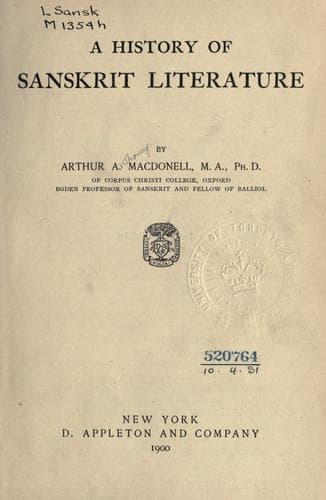
A History of Sanskrit LiteratureMacdonell, Arthur Anthony
History
A History of Sanskrit Literature
Macdonell, Arthur Anthony
Sanskrit literature -- History and criticism
The Pratiçakhya Sutra of the Rigveda is an extensive metrical work
in three books, traditionally attributed to Çaunaka, the teacher of
Açvalayana; it may, however, in its present form only be a production
of the school of Çaunaka. This Pratiçakhya was later epitomised, with
the addition of some supplementary matter, in a short treatise entitled
Upalekha. The Taittiriya Pratiçakhya is particularly interesting
owing to the various peculiar names of teachers occurring among
the twenty which it mentions. The Vajasaneyi Pratiçakhya, in eight
chapters, names Katyayana as its author, and mentions Çaunaka among
other predecessors. The Atharva-veda Pratiçakhya, in four chapters,
belonging to the school of the Çaunakas, is more grammatical than
the other works of this class.
Metre, to which there are many scattered references in the Brahmanas,
is separately treated in a section of the Çankhayana Çrauta Sutra (7,
27), in the last three sections (patalas) of the Rigveda Pratiçakhya,
and especially in the Nidana Sutra, which belongs to the Samaveda. A
part of the Chhandah Sutra of Pingala also deals with Vedic metres; but
though it claims to be a Vedanga, it is in reality a late supplement,
dealing chiefly with post-Vedic prosody, on which, indeed, it is the
standard authority.
Finally, Katyayana's two Anukramanis or indices, mentioned below,
each contains a section, varying but slightly from the other, on Vedic
metres. These sections are, however, almost identical in matter with
the sixteenth patala of the Rigveda Pratiçakhya, and may possibly be
older than the corresponding passage in the Pratiçakhya, though the
latter work as a whole is doubtless anterior to the Anukramani.
The Padapathas show that their authors had not only made investigations
as to pronunciation and Sandhi, but already knew a good deal about
the grammatical analysis of words; for they separate both the parts of
compounds and the prefixes of verbs, as well as certain suffixes and
terminations of nouns. They had doubtless already distinguished the
four parts of speech (padajatani), though these are first mentioned by
Yaska as naman, or "noun" (including sarva-naman, "representing all
nouns" or "pronouns"), akhyata, "predicate," i.e. "verb"; upasarga,
"supplement," i.e. "preposition"; nipata, "incidental addition,"
i.e. "particle." It is perhaps to the separation of these categories
that the name for grammar, vyakarana, originally referred, rather
than to the analysis of words. Even the Brahmanas bear evidence of
linguistic investigations, for they mention various grammatical
terms, such as "letter" (varna), "masculine" (vrishan), "number"
(vachana), "case-form" (vibhakti).Still more such references are to
be found in the Aranyakas, the Upanishads, and the Sutras. But the
most important information we have of pre-Paninean grammar is that
found in Yaska's work.
Public-domain text, read in full here on John Shaqi.
Reviews
Reviews
No reviews yet
Be the first to share your thoughts on this work.
Elsewhere in the archive
Join the Discussion
Join the discussion
Sign in to leave a comment or review.
Sign InorCreate an account