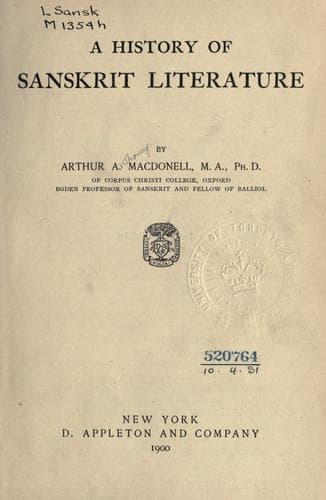
A History of Sanskrit LiteratureMacdonell, Arthur Anthony
History
A History of Sanskrit Literature
Macdonell, Arthur Anthony
Sanskrit literature -- History and criticism
Grammatical studies must have been cultivated to a considerable
extent before Yaska's time, for he distinguishes a Northern and
an Eastern school, besides mentioning nearly twenty predecessors,
among whom Çakatayana, Gargya, and Çakalya are the most important. By
the time of Yaska grammarians had learned to distinguish clearly
between the stem and the formative elements of words; recognising
the personal terminations and the tense affixes of the verb on
the one hand, and primary (krit) or secondary (taddhita) nominal
suffixes on the other. Yaska has an interesting discussion on the
theory of Çakatayana, which he himself follows, that nouns are
derived from verbs. Gargya and some other grammarians, he shows,
admit this theory in a general way, but deny that it is applicable
to all nouns. He criticises their objections, and finally dismisses
them as untenable. On Çakatayana's theory of the verbal origin
of nouns the whole system of Panini is founded. The sutra of that
grammarian contains hundreds of rules dealing with Vedic forms; but
these are of the nature of exceptions to the main body of his rules,
which are meant to describe the Sanskrit language. His work almost
entirely dominates the subsequent literature. Though belonging to
the middle of the Sutra period, it must be regarded as the definite
starting-point of the post-Vedic age. Coming to be regarded as an
infallible authority, Panini superseded all his predecessors, whose
works have consequently perished. Yaska alone survives, and that only
because he was not directly a grammarian; for his work represents,
and alone represents, the Vedanga "etymology."
Yaska's Nirukta is in reality a Vedic commentary, and is older by some
centuries than any other exegetical work preserved in Sanskrit. Its
bases are the Nighantus, collections of rare or obscure Vedic words,
arranged for the use of teachers. Yaska had before him five such
collections. The first three contain groups of synonyms, the fourth
specially difficult words, and the fifth a classification of the
Vedic gods. These Yaska explained for the most part in the twelve
books of his commentary (to which two others were added later). In
so doing he adduces as examples a large number of verses, chiefly
from the Rigveda, which he interprets with many etymological remarks.
Public-domain text, read in full here on John Shaqi.
Reviews
Reviews
No reviews yet
Be the first to share your thoughts on this work.
Elsewhere in the archive
Join the Discussion
Join the discussion
Sign in to leave a comment or review.
Sign InorCreate an account