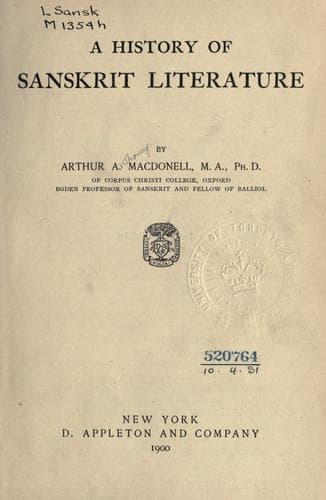
A History of Sanskrit LiteratureMacdonell, Arthur Anthony
History
A History of Sanskrit Literature
Macdonell, Arthur Anthony
Sanskrit literature -- History and criticism
There is another short index, known as yet only in two MSS., called
the Padanukramani, or "index of lines" (padas), and composed in the
same mixed metre as the others. The Suktanukramani, which has not
survived, and is only known by name, probably consisted only of the
initial words (pratikas) of the hymns. It probably perished because the
Sarvanukramani would have rendered such a work superfluous. No MS. of
the Devatanukramani or "Index of gods" exists, but ten quotations from
it have been preserved by the commentator Shadguruçishya. It must have
been superseded by the Brihaddevata, an index of the "many gods,"
a much more extensive work than any of the other Anukramanis, as it
contains about 1200 çlokas interspersed with occasional trishtubhs. It
is divided into eight adhyayas corresponding to the ashtakas of
the Rigveda. Following the order of the Rigveda, its main object
is to state the deity for each verse. But as it contains a large
number of illustrative myths and legends, it is of great value as an
early collection of stories. It is to a considerable extent based
on Yaska's Nirukta. Besides Yaska himself and other teachers named
by that scholar, it also mentions Bhaguri and Açvalayana as well as
the Nidana Sutra, A peculiarity of this work is that it refers to a
number of supplementary hymns (khilas) which do not form part of the
canonical text of the Rigveda.
Later, at least, than the original form of these metrical Anukramanis,
is the Sarvanukramani of Katyayana, which combines the data contained
in them within the compass of a single work. Composed in the Sutra
style, it is of considerable length, occupying about forty-six pages
in the printed edition. For every hymn in the Rigveda it states
the initial word or words, the number of its verses, as well as the
author, the deity, and the metre, even for single verses. There is an
introduction in twelve sections, nine of which form a short treatise on
Vedic metres corresponding to the last three sections of the Rigveda
Pratiçakhya. The author begins with the statement that he is going to
supply an index of the pratikas and so forth of the Rigveda according
to the authorities (yathopadeçam), because without such knowledge the
Çrauta and Smarta rites cannot be accomplished. These authorities are
doubtless the metrical indices described above. For the text of the
Sarvanukramani, which is composed in a concise Sutra style, not only
contains some metrical lines (padas), but also a number of passages
either directly taken from the Arshanukramani and the Brihaddevata,
or with their metrical wording but slightly altered. Another metrical
work attributed to Çaunaka is the Rigvidhana, which describes the
magical effects produced by the recitation of hymns or single verses
of the Rigveda.
Public-domain text, read in full here on John Shaqi.
Reviews
Reviews
No reviews yet
Be the first to share your thoughts on this work.
Elsewhere in the archive
Join the Discussion
Join the discussion
Sign in to leave a comment or review.
Sign InorCreate an account