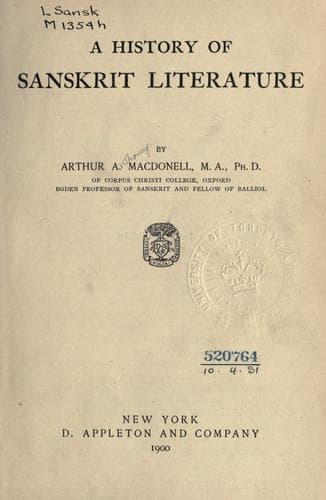
A History of Sanskrit LiteratureMacdonell, Arthur Anthony
History
A History of Sanskrit Literature
Macdonell, Arthur Anthony
Sanskrit literature -- History and criticism
Of great importance for the understanding of the sacrificial ceremonial
are the Prayogas ("Manuals") and Paddhatis ("Guides"), of which
a vast number exist in manuscript. These works represent both the
Çrauta and the Grihya ritual according to the various schools. The
Prayogas describe the course of each sacrifice and the functions
of the different groups of priests, solely from the point of view
of practical performance, while the Paddhatis rather follow the
systematic accounts of the Sutras and sketch their contents. There
are also versified accounts of the ritual called Karikas, which
are directly attached to Sutras or to Paddhatis. The oldest of them
appears to be the Karika of Kumarila (c. 700 A.D.).
Of a supplementary character are also the class of writings called
Anukramanis or Vedic Indices, which give lists of the hymns, the
authors, the metres, and the deities in the order in which they
occur in the various Samhitas. To the Rigveda belonged seven of these
works, all attributed to Çaunaka, and composed in the mixture of the
çloka and trishtubh metre, which is also found in Çaunaka's Rigveda
Pratiçakhya. There is also a General Index or Sarvanukramani which is
attributed to Katyayana, and epitomises in the Sutra style the contents
of the metrical indices. Of the metrical indices five have been
preserved. The Arshanukramani, containing rather less than 300 çlokas,
gives a list of the Rishis or authors of the Rigveda. Its present text
represents a modernised form of that which was known to the commentator
Shadguruçishya in the twelfth century. The Chhandonukramani, which
is of almost exactly the same length, enumerates the metres in which
the hymns of the Rigveda are composed. It also states for each book
the number of verses in each metre as well as the aggregate in all
metres. The Anuvakanukramani is a short index containing only about
forty verses. It states the initial words of each of the eighty-five
anuvakas or lessons into which the Rigveda is divided, and the
number of hymns contained in these anuvakas. It further states that
the Rigveda contains 1017 hymns (or 1025 according to the Vashkala
recension), 10,580-1/2 verses, 153,826 words, 432,000 syllables,
besides some other statistical details. The number of verses given does
not exactly tally with various calculations that have recently been
made, but the differences are only slight, and may be due to the way in
which certain repeated verses were counted by the author of the index.
Public-domain text, read in full here on John Shaqi.
Reviews
Reviews
No reviews yet
Be the first to share your thoughts on this work.
Elsewhere in the archive
Join the Discussion
Join the discussion
Sign in to leave a comment or review.
Sign InorCreate an account