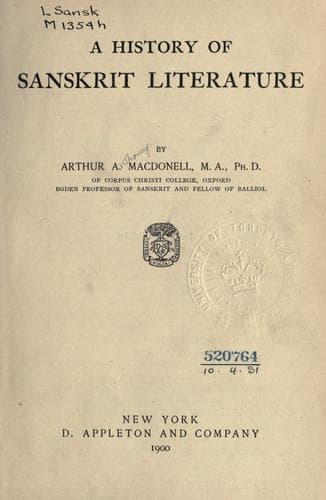
A History of Sanskrit LiteratureMacdonell, Arthur Anthony
History
A History of Sanskrit Literature
Macdonell, Arthur Anthony
Sanskrit literature -- History and criticism
In concluding this account of Vedic literature, I cannot omit to say
a few words about Sayana, the great mediæval Vedic scholar, to whom
or to whose initiation we owe a number of valuable commentaries on the
Rigveda, the Aitareya Brahmana and Aranyaka, as well as the Taittiriya
Samhita, Brahmana, and Aranyaka, besides a number of other works. His
comments on the two Samhitas would appear to have been only partially
composed by himself and to have been completed by his pupils. He died
in 1387, having written his works under Bukka I. (1350-79), whose
teacher and minister he calls himself, and his successor, Harihara
(1379-99). These princes belonged to a family which, throwing off
the Muhammadan yoke in the earlier half of the fourteenth century,
founded the dynasty of Vijayanagara ("city of victory"), now Hampi,
on the Tungabhadra, in the Bellary district. Sayana's elder brother,
Madhava, was minister of King Bukka, and died as abbot of the monastery
of Çringeri, under the name of Vidyaranyasvamin. Not only did he too
produce works of his own, but Sayana's commentaries, as composed under
his patronage, were dedicated to him as madhaviya, or ("influenced
by Madhava"). By an interesting coincidence Professor Max Müller's
second edition of the Rigveda, with the commentary of Sayana, was
brought out under the auspices of a Maharaja of Vijayanagara. The
latter city has, however, nothing to do with that from which King
Bukka derived his title.
CHAPTER X
THE EPICS
(Circa 500-50 B.C.)
In turning from the Vedic to the Sanskrit period, we are confronted
with a literature which is essentially different from that of
the earlier age in matter, spirit, and form. Vedic literature is
essentially religious; Sanskrit literature, abundantly developed in
every other direction, is profane. But, doubtless as a result of the
speculative tendencies of the Upanishads, a moralising spirit at the
same time breathes through it as a whole. The religion itself which now
prevails is very different from that of the Vedic age. For in the new
period the three great gods, Brahma, Vishnu, and Çiva are the chief
objects of worship. The important deities of the Veda have sunk to a
subordinate position, though Indra is still relatively prominent as the
chief of a warrior's heaven. Some new gods of lesser rank have arisen,
such as Kubera, god of wealth; Ganeça, god of learning; Karttikeya,
god of war; Çri or Lakshmi, goddess of beauty and fortune; Durga or
Parvati, the terrible spouse of Çiva; besides the serpent deities
and several classes of demigods and demons.
Public-domain text, read in full here on John Shaqi.
Reviews
Reviews
No reviews yet
Be the first to share your thoughts on this work.
Elsewhere in the archive
Join the Discussion
Join the discussion
Sign in to leave a comment or review.
Sign InorCreate an account