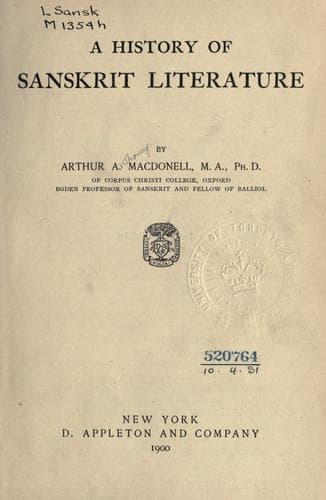
A History of Sanskrit LiteratureMacdonell, Arthur Anthony
History
A History of Sanskrit Literature
Macdonell, Arthur Anthony
Sanskrit literature -- History and criticism
While the spirit of Vedic literature, at least in its earlier phase,
is optimistic, Sanskrit poetry is pervaded by Weltschmerz, resulting
from the now universally accepted doctrine of transmigration. To
that doctrine, according to which beings pass by gradations from
Brahma through men and animals to the lowest forms of existence,
is doubtless also largely due the fantastic element characteristic
of this later poetry. Here, for instance, we read of Vishnu coming
down to earth in the shape of animals, of sages and saints wandering
between heaven and earth, of human kings visiting Indra in heaven.
Hand in hand with this fondness for introducing the marvellous and
supernatural into the description of human events goes a tendency to
exaggeration. Thus King Viçvamitra, we are told, practised penance
for thousands of years in succession; and the power of asceticism
is described as so great as to cause even the worlds and the gods to
tremble. The very bulk of the Mahabharata, consisting as it does of
more than 200,000 lines, is a concrete illustration of this defective
sense of proportion.
As regards the form in which it is presented to us, Sanskrit
literature contrasts with that of both the earlier and the later
Vedic period. While prose was employed in the Yajurvedas and the
Brahmanas, and finally attained to a certain degree of development,
it almost disappears in Sanskrit, nearly every branch of literature
being treated in verse, often much to the detriment of the subject,
as in the case of law. The only departments almost entirely restricted
to the use of prose are grammar and philosophy, but the cramped and
enigmatical style in which these subjects are treated hardly deserves
the name of prose at all. Literary prose is found only in fables,
fairy tales, romances, and partially in the drama. In consequence of
this neglect, the prose of the later period compares unfavourably with
that of the Brahmanas. Even the style of the romances or prose kavyas,
subject as it is to the strict rules of poetics, is as clumsy as that
of the grammatical commentaries; for the use of immense compounds,
like those of the Sutras, is one of its essential characteristics.
Sanskrit literature, then, resembles that of the earlier Vedic age in
being almost entirely metrical. But the metres in which it is written,
though nearly all based on those of the Veda, are different. The bulk
of the literature is composed in the çloka, a development of the Vedic
anushtubh stanza of four octosyllabic lines; but while all four lines
ended iambically in the prototype, the first and third line have
in the çloka acquired a trochaic rhythm. The numerous other metres
employed in the classical poetry have become much more elaborate
than their Vedic originals by having the quantity of every syllable
in the line strictly determined.
Public-domain text, read in full here on John Shaqi.
Reviews
Reviews
No reviews yet
Be the first to share your thoughts on this work.
Elsewhere in the archive
Join the Discussion
Join the discussion
Sign in to leave a comment or review.
Sign InorCreate an account