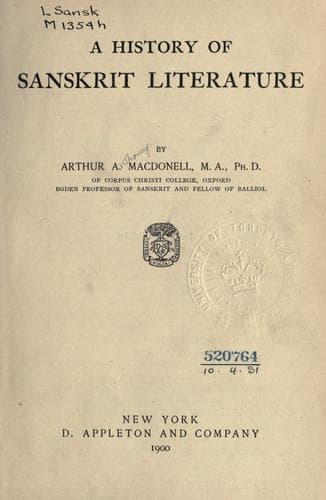
A History of Sanskrit LiteratureMacdonell, Arthur Anthony
History
A History of Sanskrit Literature
Macdonell, Arthur Anthony
Sanskrit literature -- History and criticism
The epic kernel of the Mahabharata or the "Great Battle of the
descendants of Bharata," consisting of about 20,000 çlokas, describes
the eighteen days' fight between Duryodhana, leader of the Kurus, and
Yudhishthira, chief of the Pandus, who were cousins, both descended
from King Bharata, son of Çakuntala. Within this narrative frame has
come to be included a vast number of old legends about gods, kings, and
sages; accounts of cosmogony and theogony; disquisitions on philosophy,
law, religion, and the duties of the military caste. These lengthy
and heterogeneous interpolations render it very difficult to follow
the thread of the narrative. Entire works are sometimes inserted to
illustrate a particular statement. Thus, while the two armies are
drawn up prepared for battle, a whole philosophical poem, in eighteen
cantos, the Bhagavadgita is recited to the hero Arjuna, who hesitates
to advance and fight against his kin. Hence the Mahabharata claims
to be not only a heroic poem (kavya), but a compendium teaching,
in accordance with the Veda, the fourfold end of human existence
(spiritual merit, wealth, pleasure, and salvation), a smriti or work
of sacred tradition, which expounds the whole duty of man, and is
intended for the religious instruction of all Hindus. Thus, in one
(I. lxii. 35) of many similar passages, it makes the statement
about itself that "this collection of all sacred texts, in which
the greatness of cows and Brahmans is exalted, must be listened
to by virtuous-minded men." Its title, Karshna Veda, or "Veda of
Krishna" (a form of Vishnu), the occurrence of a famous invocation
of Narayana and Nara (names of Vishnu) and Sarasvati (Vishnu's wife)
at the beginning of each of its larger sections, and the prevalence
of Vishnuite doctrines throughout the work, prove it to have been a
smriti of the ancient Vishnuite sect of the Bhagavatas.
Thus it is clear that the Mahabharata in its present shape contains
an epic nucleus, that it favours the worship of Vishnu, and that it
has become a comprehensive didactic work. We further find in Book
I. the direct statements that the poem at one time contained 24,000
çlokas before the episodes (upakhyana) were added, that it originally
consisted of only 8800 çlokas, and that it has three beginnings. These
data render it probable that the epic underwent three stages of
development from the time it first assumed definite shape; and this
conclusion is corroborated by various internal and external arguments.
Public-domain text, read in full here on John Shaqi.
Reviews
Reviews
No reviews yet
Be the first to share your thoughts on this work.
Elsewhere in the archive
Join the Discussion
Join the discussion
Sign in to leave a comment or review.
Sign InorCreate an account