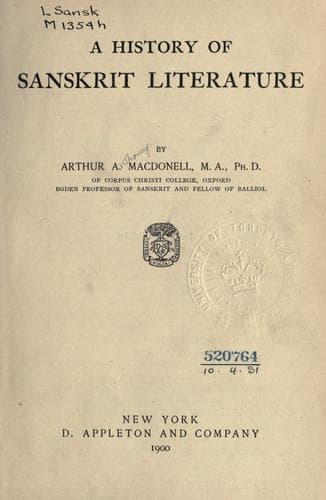
A History of Sanskrit LiteratureMacdonell, Arthur Anthony
History
A History of Sanskrit Literature
Macdonell, Arthur Anthony
Sanskrit literature -- History and criticism
There can be little doubt that the original kernel of the epic has as a
historical background an ancient conflict between the two neighbouring
tribes of the Kurus and Panchalas, who finally coalesced into a single
people. In the Yajurvedas these two tribes already appear united,
and in the Kathaka King Dhritarashtra Vaichitravirya, one of the chief
figures of the Mahabharata, is mentioned as a well-known person. Hence
the historical germ of the great epic is to be traced to a very early
period, which cannot well be later than the tenth century B.C. Old
songs about the ancient feud and the heroes who played a part in it,
must have been handed down by word of mouth and recited in popular
assemblies or at great public sacrifices.
These disconnected battle-songs were, we must assume, worked up by some
poetic genius into a comparatively short epic, describing the tragic
fate of the Kuru race, who, with justice and virtue on their side,
perished through the treachery of the victorious sons of Pandu, with
Krishna at their head. To the period of this original epic doubtless
belong the traces the Mahabharata has preserved unchanged of the
heroic spirit and the customs of ancient times, so different from the
later state of things which the Mahabharata as a whole reflects. To
this period also belongs the figure of Brahma as the highest god. The
evidence of Pali literature shows that Brahma already occupied that
position in Buddha's time. We may, then, perhaps assume that the
original form of our epic came into being about the fifth century
B.C. The oldest evidence we have for the existence of the Mahabharata
in some shape or other is to be found in Açvalayana's Grihya Sutra,
where a Bharata and Mahabharata are mentioned. This would also point
to about the fifth century B.C.
To the next stage, in which the epic, handed down by rhapsodists,
swelled to a length of about 20,000 çlokas, belongs the representation
of the victorious Pandus in a favourable light, and the introduction on
a level with Brahma of the two other great gods, Çiva, and especially
Vishnu, of whom Krishna appears as an incarnation.
We gather from the account of Megasthenes that about 300 B.C.,
these two gods were already prominent, and the people were divided
into Çivaites and Vishnuites. Moreover, the Yavanas or Greeks are
mentioned in the Mahabharata as allies of the Kurus, and even the Çakas
(Scythians) and Pahlavas (Parthians) are named along with them; Hindu
temples are also referred to as well as Buddhist relic mounds. Thus
an extension of the original epic must have taken place after 300
B.C. and by the beginning of our era.
Public-domain text, read in full here on John Shaqi.
Reviews
Reviews
No reviews yet
Be the first to share your thoughts on this work.
Elsewhere in the archive
Join the Discussion
Join the discussion
Sign in to leave a comment or review.
Sign InorCreate an account