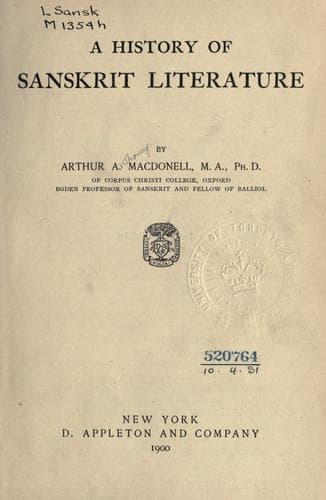
A History of Sanskrit LiteratureMacdonell, Arthur Anthony
History
A History of Sanskrit Literature
Macdonell, Arthur Anthony
Sanskrit literature -- History and criticism
The great Vedantist philosopher Çankaracharya, who wrote his
commentary in 804 A.D., often quotes the Mahabharata as a Smriti,
and in discussing a verse from Book XII. expressly states that the
Mahabharata was intended for the religious instruction of those
classes who by their position are debarred from studying the Vedas
and the Vedanta.
From the middle of the eleventh century A.D. we have the oldest
known abstract of the Mahabharata, the work of the Kashmirian poet
Kshemendra, entitled Bharata-Manjari. This condensation is specially
important, because it enables the scholar to determine the state of the
text in detail at that time. Professor Bühler's careful comparison of
the MSS. of this work with the great epic has led him to the conclusion
that Kshemendra's original did not differ from the Mahabharata as we
have it at present in any other way than two classes of MSS. differ
from each other. This poetical epitome shows several omissions,
but these are on the whole of such a nature as is to be expected in
any similar abridgment. It is, however, likely that twelve chapters
(342-353) of Book XII., treating of Narayana, which the abbreviator
passes over, did not exist in the original known to him. There can,
moreover, be no doubt that the forms of several proper names found in
the Manjari are better and older than those given by the editions of
the Mahabharata. Though the division of the original into eighteen
books is found in the abridgment also, it is made up by turning the
third section (gada-parvan) of Book IX. (çalya-parvan) into a separate
book, while combining Books XII. and XIII. into a single one. This
variation probably represents an old division, as it occurs in many
MSS. of the Mahabharata.
Another work of importance in determining the state of the Mahabharata
is a Javanese translation of the epic, also dating from the eleventh
century.
The best-known commentator of the Mahabharata is Nilakantha, who
lived at Kurpara, to the west of the Godavari, in Maharashtra, and,
according to Burnell, belongs to the sixteenth century. Older than
Nilakantha, who quotes him, is Arjuna Miçra, whose commentary, along
with that of Nilakantha, appears in an edition of the Mahabharata
begun at Calcutta in 1875. The earliest extant commentator of the
great epic is Sarvajna Narayana, large fragments of whose notes have
been preserved, and who cannot have written later than in the second
half of the fourteenth century, but may be somewhat older.
Public-domain text, read in full here on John Shaqi.
Reviews
Reviews
No reviews yet
Be the first to share your thoughts on this work.
Elsewhere in the archive
Join the Discussion
Join the discussion
Sign in to leave a comment or review.
Sign InorCreate an account