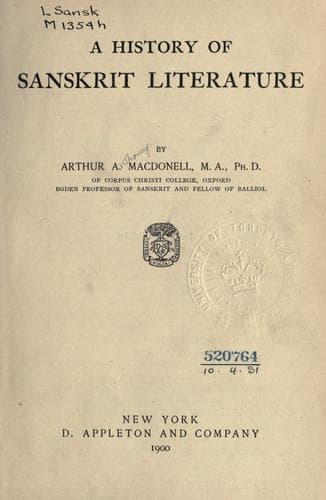
A History of Sanskrit LiteratureMacdonell, Arthur Anthony
History
A History of Sanskrit Literature
Macdonell, Arthur Anthony
Sanskrit literature -- History and criticism
The literary evidence of Sanskrit authors from about 600 to 1100
A.D. supplies us with a considerable amount of information as to the
state of the great epic during those five centuries. An examination
of the works of Bana, and of his predecessor Subandhu, shows that
these authors, who belong to the beginning of the seventh century,
not only studied and made use of legends from every one of the
eighteen books of the Mahabharata for the poetical embellishment of
their works, but were even acquainted with the Harivamça. We also
know that in Bana's time the Bhagavadgita was included in the great
epic. The same writer mentions that the Mahabharata was recited in
the temple of Mahakala at Ujjain. That such recitation was already a
widespread practice at that time is corroborated by an inscription
of about 600 A.D. from the remote Indian colony of Kamboja, which
states that copies of the Mahabharata, as well as of the Ramayana
and of an unnamed Purana, were presented to a temple there, and that
the donor had made arrangements to ensure their daily recitation in
perpetuity. This evidence shows that the Mahabharata cannot have
been a mere heroic poem, but must have borne the character of a
Smriti work of long-established authority. Even at the present day
both public and private recitations of the Epics and Puranas are
common in India, and are always instituted for the edification and
religious instruction of worshippers in temples or of members of
the family. As a rule, the Sanskrit texts are not only declaimed,
but also explained in the vernacular tongue for the benefit both of
women, and of such males as belong to classes unacquainted with the
learned language of the Brahmans.
We next come to the eminent Mimamsa philosopher Kumarila, who has
been proved to have flourished in the first half of the eighth
century A.D. In the small portion of his great commentary, entitled
Tantra-varttika, which has been examined, no fewer than ten of the
eighteen books of the Mahabharata are named, quoted, or referred to. It
is clear that the epic as known to him not only included the first book
(adiparvan), but that that book in his time closely resembled the form
of its text which we possess. It even appears to have contained the
first section, called anukramanika or "Survey of contents," and the
second, entitled parva-samgraha or "Synopsis of sections." Kumarila
also knew Books XII. and XIII., which have frequently been pronounced
to be of late origin, as well as XIX. It is evident from his treatment
of the epic that he regarded it as a work of sacred tradition and of
great antiquity, intended from the beginning for the instruction of all
the four castes. To him it is not an account of the great war between
the Kauravas and Pandus; the descriptions of battles were only used
for the purpose of rousing the martial instincts of the warrior caste.
Public-domain text, read in full here on John Shaqi.
Reviews
Reviews
No reviews yet
Be the first to share your thoughts on this work.
Elsewhere in the archive
Join the Discussion
Join the discussion
Sign in to leave a comment or review.
Sign InorCreate an account