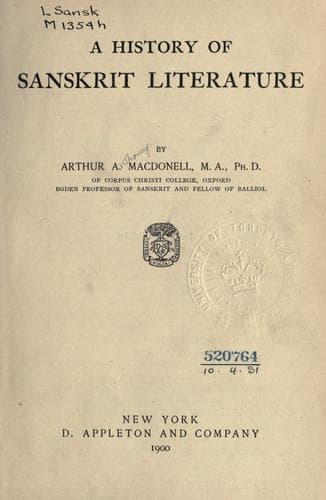
A History of Sanskrit LiteratureMacdonell, Arthur Anthony
History
A History of Sanskrit Literature
Macdonell, Arthur Anthony
Sanskrit literature -- History and criticism
The supplementary book, the Harivamça, or "Family of Vishnu," is
concerned only with Krishna. It contains more than 16,000 çlokas,
and is divided into three sections. The first of these describes
the history of Krishna's ancestors down to the time of Vishnu's
incarnation in him; the second gives an account of Krishna's exploits;
the third treats of the future corruptions of the Kali, or fourth
age of the world.
The episodes of the Mahabharata are numerous and often very extensive,
constituting, as we have seen, about four-fifths of the whole
poem. Many of them are interesting for various reasons, and some are
distinguished by considerable poetic beauty. One of them, the story of
Çakuntala (occurring in Book I.), supplied Kalidasa with the subject
of his famous play. Episodes are specially plentiful in Book III.,
being related to while away the time of the exiled Pandus. Here is
found the Matsyopakhyana, or "Episode of the fish," being the story of
the flood, narrated with more diffuseness than the simple story told
in the Çatapatha Brahmana. The fish here declares itself to be Brahma,
Lord of creatures, and not yet Vishnu, as in the Bhagavata Purana. Manu
no longer appears as the progenitor of mankind, but as a creator who
produces all beings and worlds anew by means of his ascetic power.
Another episode is the history of Rama, interesting in its relation to
Valmiki's Ramayana, which deals with the same subject at much greater
length. The myth of the descent of the Ganges from heaven to earth,
here narrated, is told in the Ramayana also.
Another legend is that of the sage Riçya-çringa, who having produced
rain in the country of Lomapada, king of the Angas, was rewarded with
the hand of the princess Çanta, and performed that sacrifice for
King Daçaratha which brought about the birth of Rama. This episode
is peculiarly important from a critical point of view, as the legend
recurs not only in the Ramayana, but also in the Padma Purana, the
Skanda Purana, and a number of other sources.
Of special interest is the story of King Uçinara, son of Çibi,
who sacrificed his life to save a pigeon from a hawk. It is told
again in another part of Book III. about Çibi himself, as well as in
Book XIII. about Vrishadarbha, son of Çibi. Distinctly Buddhistic in
origin and character, the story is famous in Pali as well as Sanskrit
literature, and spread beyond the limits of India.
The story of the abduction of Draupadi forms an episode of her life
while she dwelt with the Pandus in the Kamyaka forest. Accidentally
seen when alone by King Jayadratha of Sindhu, who was passing with a
great army, and fell in love with her at first sight, she was forcibly
carried off, and only rescued after a terrible fight, in which the
Pandus annihilated Jayadratha's host.
Public-domain text, read in full here on John Shaqi.
Reviews
Reviews
No reviews yet
Be the first to share your thoughts on this work.
Elsewhere in the archive
Join the Discussion
Join the discussion
Sign in to leave a comment or review.
Sign InorCreate an account