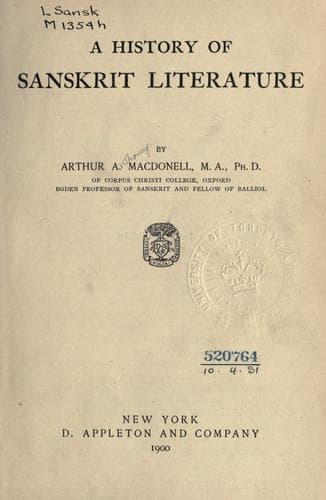
A History of Sanskrit LiteratureMacdonell, Arthur Anthony
History
A History of Sanskrit Literature
Macdonell, Arthur Anthony
Sanskrit literature -- History and criticism
Interesting as an illustration of the mythological ideas of the
age is the episode which describes the journey of Arjuna to Indra's
heaven. Here we see the mighty warrior-god of the Vedas transformed
into a glorified king of later times, living a life of ease amid
the splendours of his celestial court, where the ear is lulled by
strains of music, while the eye is ravished by the graceful dancing
and exquisite beauty of heavenly nymphs.
In the story of Savitri we have one of the finest of the many
ideal female characters which the older epic poetry of India has
created. Savitri, daughter of Açvapati, king of Madra, chooses as
her husband Satyavat, the handsome and noble son of a blind and
exiled king, who dwells in a forest hermitage. Though warned by the
sage Narada that the prince is fated to live but a single year, she
persists in her choice, and after the wedding departs with her husband
to his father's forest retreat. Here she lives happily till she begins
to be tortured with anxiety on the approach of the fatal day. When
it arrives, she follows her husband on his way to cut wood in the
forest. After a time he lies down exhausted. Yama, the god of death,
appears, and taking his soul, departs. As Savitri persistently follows
him, Yama grants her various boons, always excepting the life of her
husband; but yielding at last to her importunities, he restores the
soul to the lifeless body. Satyavat recovers, and lives happily for
many years with his faithful Savitri.
One of the oldest and most beautiful stories inserted in the
Mahabharata is the Nalopakhyana, or "Episode of Nala." It is one of the
least corrupted of the episodes, its great popularity having prevented
the transforming hand of an editor from introducing Çiva and Vishnu,
or from effacing the simplicity of the manners it depicts--the prince,
for instance, cooks his own food--or from changing the character of
Indra, and other old traits. The poem is pervaded by a high tone of
morality, manifested above all in the heroic devotion and fidelity
of Damayanti, its leading character. It also contains many passages
distinguished by tender pathos.
The story is told by the wise Brihadaçva to the exiled Yudhishthira,
in order to console him for the loss of the kingdom he has forfeited
at play. Nala, prince of Nishada, chosen from among many competitors
for her hand by Damayanti, princess of Vidarbha, passes several
years of happy married life with her. Then, possessed by the demon
Kali, and indulging in gambling, he loses his kingdom and all his
possessions. Wandering half naked in the forest with Damayanti, he
abandons her in his frenzy. Very pathetic is the scene describing
how he repeatedly returns to the spot where his wife lies asleep on
the ground before he finally deserts her. Equally touching are the
accounts of her terror on awaking to find herself alone in the forest,
and of her lamentations as she roams in search of her husband, and
calls out to him--
Public-domain text, read in full here on John Shaqi.
Reviews
Reviews
No reviews yet
Be the first to share your thoughts on this work.
Elsewhere in the archive
Join the Discussion
Join the discussion
Sign in to leave a comment or review.
Sign InorCreate an account