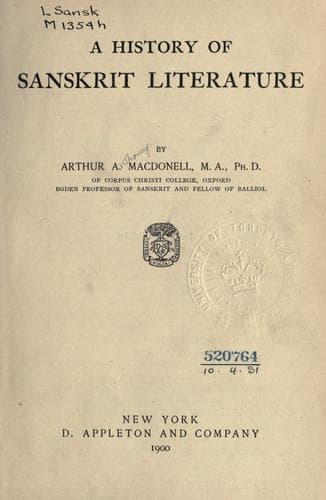
A History of Sanskrit LiteratureMacdonell, Arthur Anthony
History
A History of Sanskrit Literature
Macdonell, Arthur Anthony
Sanskrit literature -- History and criticism
As to the place of its origin, there is good reason for believing that
the Ramayana arose in Kosala, the country ruled by the race of Ikshvaku
in Ayodhya (Oudh). For we are told in the seventh book (canto 45)
that the hermitage of Valmiki lay on the south bank of the Ganges; the
poet must further have been connected with the royal house of Ayodhya,
as the banished Sita took refuge in his hermitage, where her twin
sons were born, brought up, and later learnt the epic from his lips;
and lastly, the statement is made in the first book (canto 5) that
the Ramayana arose in the family of the Ikshvakus. In Ayodhya, then,
there must have been current among the court bards (suta) a number
of epic tales narrating the fortunes of the Ikshvaku hero Rama. Such
legends, we may assume, Valmiki worked up into a single homogeneous
production, which, as the earliest epic of importance conforming
to the rules of poetics, justly received the name of adi-kavya, or
"first artificial poem," from its author's successors. This work was
then learnt by professional rhapsodists (kuçilava) and recited by
them in public as they wandered about the country.
The original part of the Ramayana appears to have been completed
at a time when the epic kernel of the Mahabharata had not as yet
assumed definite shape. For while the heroes of the latter are not
mentioned in the Ramayana, the story of Rama is often referred to in
the longer epic. Again, in a passage of Book VII. of the Mahabharata,
which cannot be regarded as a later addition, two lines are quoted as
Valmiki's that occur unaltered in Book VI. of the Ramayana. The poem
of Valmiki must, therefore, have been generally known as an old work
before the Mahabharata assumed a coherent form. In Book III. (cantos
277-291) of the latter epic, moreover, there is a Ramopakhyana or
"Episode of Rama," which seems to be based on the Ramayana as it
contains several verses agreeing more or less with Valmiki's lines,
and its author presupposes on the part of his audience a knowledge
of the Ramayana as represented by the Bombay recension.
Public-domain text, read in full here on John Shaqi.
Reviews
Reviews
No reviews yet
Be the first to share your thoughts on this work.
Elsewhere in the archive
Join the Discussion
Join the discussion
Sign in to leave a comment or review.
Sign InorCreate an account