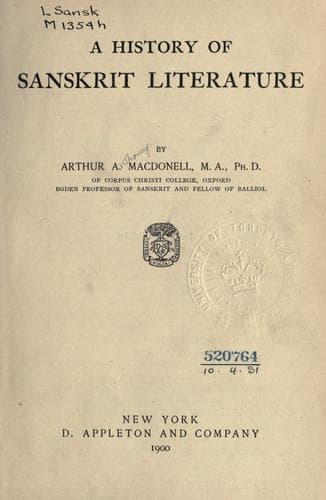
A History of Sanskrit LiteratureMacdonell, Arthur Anthony
History
A History of Sanskrit Literature
Macdonell, Arthur Anthony
Sanskrit literature -- History and criticism
The careful investigations of Professor Jacobi have shown that the
Ramayana originally consisted of five books only (ii.-vi.). The
seventh is undoubtedly a later addition, for the conclusion of the
sixth was evidently at one time the end of the whole poem. Again,
the first book has several passages which conflict with statements
in the later books. It further contains two tables of contents (in
cantos i. and iii.) which were clearly made at different times; for
one of them takes no notice of the first and last books, and must,
therefore, have been made before these were added. What was obviously
a part of the commencement of the original poem has been separated
from its continuation at the opening of Book II., and now forms the
beginning of the fifth canto of Book I. Some cantos have also been
interpolated in the genuine books. As Professor Jacobi shows, all these
additions to the original body of the epic have been for the most part
so loosely attached that the junctures are easy to recognise. They
are, however, pervaded by the same spirit as the older part. There
is, therefore, no reason for the supposition that they are due to a
Brahman revision intended to transform a poem originally meant for
the warrior caste. They seem rather to owe their origin simply to the
desire of professional rhapsodists to meet the demands of the popular
taste. We are told in the Ramayana itself that the poem was either
recited by professional minstrels or sung to the accompaniment of
a stringed instrument, being handed down orally, in the first place
by Rama's two sons Kuça and Lava. These names are nothing more than
the inventions of popular etymology meant to explain the Sanskrit
word kuçilava, "bard" or "actor." The new parts were incorporated
before the three recensions which have come down to us arose, but
a considerable time must have elapsed between the composition of
the original poem and that of the additions. For the tribal hero of
the former has in the latter been transformed into a national hero,
the moral ideal of the people; and the human hero (like Krishna in the
Mahabharata) of the five genuine books (excepting a few interpolations)
has in the first and last become deified and identified with the god
Vishnu, his divine nature in these additions being always present to
the minds of their authors. Here, too, Valmiki, the composer of the
Ramayana, appears as a contemporary of Rama, and is already regarded
as a seer. A long interval of time must have been necessary for such
transformations as these.
Public-domain text, read in full here on John Shaqi.
Reviews
Reviews
No reviews yet
Be the first to share your thoughts on this work.
Elsewhere in the archive
Join the Discussion
Join the discussion
Sign in to leave a comment or review.
Sign InorCreate an account