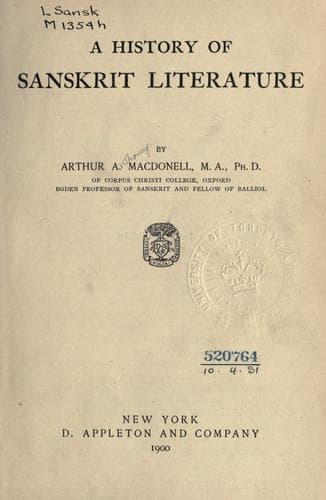
A History of Sanskrit LiteratureMacdonell, Arthur Anthony
History
A History of Sanskrit Literature
Macdonell, Arthur Anthony
Sanskrit literature -- History and criticism
The political aspect of Eastern India as revealed by the Ramayana sheds
some additional light on the age of the epic. In the first place, no
mention is made of the city of Pataliputra (Patna), which was founded
by King Kalaçoka (under whom the second Buddhist council was held at
Vaiçali about 380 B.C.), and which by the time of Megasthenes (300
B.C.) had become the capital of India. Yet Rama is in Book I. (canto
35) described as passing the very spot where that city stood, and the
poet makes a point (in cantos 32-33) of referring to the foundation of
a number of cities in Eastern Hindustan, such as Kauçambi, Kanyakubja,
and Kampilya, in order to show how far the fame of the Ramayana spread
beyond the confines of Kosala, the land of its origin. Had Pataliputra
existed at the time, it could not have failed to be mentioned.
It is further a noteworthy fact that the capital of Kosala is in
the original Ramayana regularly called Ayodhya, while the Buddhists,
Jains, Greeks, and Patanjali always give it the name of Saketa. Now
in the last book of the Ramayana we are told that Rama's son, Lava,
fixed the seat of his government at Çravasti, a city not mentioned at
all in the old part of the epic; and in Buddha's time King Prasenajit
of Kosala is known to have reigned at Çravasti. All this points to the
conclusion that the original Ramayana was composed when the ancient
Ayodhya had not yet been deserted, but was still the chief city of
Kosala, when its new name of Saketa was still unknown, and before
the seat of government was transferred to Çravasti.
Again, in the old part of Book I., Mithila and Viçala are spoken of
as twin cities under separate rulers, while we know that by Buddha's
time they had coalesced to the famous city of Vaiçali, which was then
ruled by an oligarchy.
The political conditions described in the Ramayana indicate the
patriarchal rule of kings possessing only a small territory, and never
point to the existence of more complex states; while the references of
the poets of the Mahabharata to the dominions in Eastern India ruled by
a powerful king, Jarasandha, and embracing many lands besides Magadha,
reflect the political conditions of the fourth century B.C. The
cumulative evidence of the above arguments makes it difficult to
avoid the conclusion that the kernel of the Ramayana was composed
before 500 B.C., while the more recent portions were probably not
added till the second century B.C. and later.
Public-domain text, read in full here on John Shaqi.
Reviews
Reviews
No reviews yet
Be the first to share your thoughts on this work.
Elsewhere in the archive
Join the Discussion
Join the discussion
Sign in to leave a comment or review.
Sign InorCreate an account