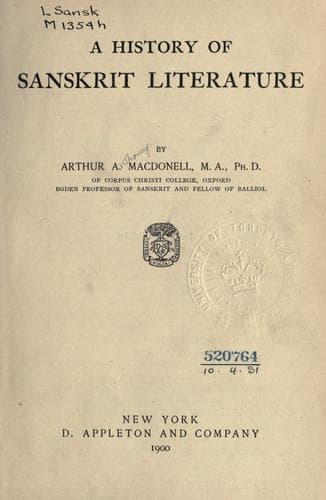
A History of Sanskrit LiteratureMacdonell, Arthur Anthony
History
A History of Sanskrit Literature
Macdonell, Arthur Anthony
Sanskrit literature -- History and criticism
This conclusion does not at first sight seem to be borne out by the
linguistic evidence of the Ramayana, For the epic (arsha) dialect of
the Bombay recension, which is practically the same as that of the
Mahabharata, both betrays a stage of development decidedly later than
that of Panini, and is taken no notice of by that grammarian. But it
is, for all that, not necessarily later in date. For Panini deals only
with the refined Sanskrit of the cultured (çishta), that is to say,
of the Brahmans, which would be more archaic than the popular dialect
of wandering rhapsodists; and he would naturally have ignored the
latter. Now at the time of the Açoka inscriptions, or hardly more
than half a century later than Panini, Prakrit was the language of
the people in the part of India where the Ramayana was composed. It
is, therefore, not at all likely that the Ramayana, which aimed at
popularity, should have been composed as late as the time of Panini,
when it could not have been generally understood. If the language of
the epic is later than Panini, it is difficult to see how it escaped
the dominating influence of his grammar. It is more likely that the
popular Sanskrit of the epics received general currency at a much
earlier date by the composition of a poem like that of Valmiki. A
searching comparative investigation of the classical Kavyas will
probably show that they are linguistically more closely connected
with the old epic poetry, and that they deviate more from the Paninean
standard than is usually supposed.
In style the Ramayana is already far removed from the naïve
popular epic, in which the story is the chief thing, and not its
form. Valmiki is rich in similes, which he often cumulates; he not
infrequently uses the cognate figure called rupaka or "identification"
(e.g. "foot-lotus") with much skill, and also occasionally employs
other ornaments familiar to the classical poets, besides approximating
to them in the style of his descriptions. The Ramayana, in fact,
represents the dawn of the later artificial poetry (kavya), which
was in all probability the direct continuation and development of the
art handed down by the rhapsodists who recited Valmiki's work. Such
a relationship is distinctly recognised by the authors of the great
classical epics (mahakavis) when they refer to him as the adi-kavi or
"first poet."
Public-domain text, read in full here on John Shaqi.
Reviews
Reviews
No reviews yet
Be the first to share your thoughts on this work.
Elsewhere in the archive
Join the Discussion
Join the discussion
Sign in to leave a comment or review.
Sign InorCreate an account