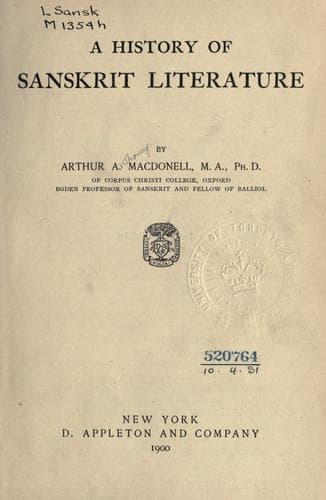
A History of Sanskrit LiteratureMacdonell, Arthur Anthony
History
A History of Sanskrit Literature
Macdonell, Arthur Anthony
Sanskrit literature -- History and criticism
There is much more probability in the opinion of Jacobi, that
the Ramayana contains no allegory at all, but is based on Indian
mythology. The foundation of the second part would thus be a celestial
myth of the Veda transformed into a narrative of earthly adventures
according to a not uncommon development. Sita, can be traced to the
Rigveda, where she appears as the Furrow personified and invoked as a
goddess. In some of the Grihya Sutras she again appears as a genius
of the ploughed field, is praised as a being of great beauty, and
is accounted the wife of Indra or Parjanya, the rain-god. There are
traces of this origin in the Ramayana itself. For Sita is represented
(i. 66) as having emerged from the earth when her father Janaka was
once ploughing, and at last she disappears underground in the arms
of the goddess Earth (vii. 97). Her husband, Rama, would be no other
than Indra, and his conflict with Ravana, chief of the demons, would
represent the Indra-Vritra myth of the Rigveda. This identification
is confirmed by the name of Ravana's son being Indrajit, "Conqueror
of Indra," or Indraçatru, "Foe of Indra," the latter being actually
an epithet of Vritra in the Rigveda. Ravana's most notable feat, the
rape of Sita, has its prototype in the stealing of the cows recovered
by Indra. Hanumat, the chief of the monkeys and Rama's ally in the
recovery of Sita, is the son of the wind-god, with the patronymic
Maruti, and is described as flying hundreds of leagues through the air
to find Sita. Hence in his figure perhaps survives a reminiscence of
Indra's alliance with the Maruts in his conflict with Vritra, and of
the dog Sarama, who, as Indra's messenger, crosses the waters of the
Rasa and tracks the cows. Sarama recurs as the name of a demoness who
consoles Sita in her captivity. The name of Hanumat being Sanskrit,
the character is probably not borrowed from the aborigines. As Hanumat
is at the present day the tutelary deity of village settlements all
over India, Prof. Jacobi's surmise that he must have been connected
with agriculture, and may have been a genius of the monsoon, has
some probability.
Public-domain text, read in full here on John Shaqi.
Reviews
Reviews
No reviews yet
Be the first to share your thoughts on this work.
Elsewhere in the archive
Join the Discussion
Join the discussion
Sign in to leave a comment or review.
Sign InorCreate an account