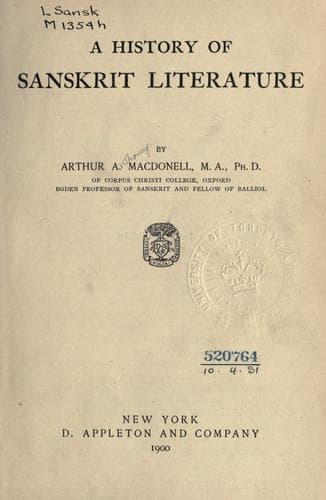
A History of Sanskrit LiteratureMacdonell, Arthur Anthony
History
A History of Sanskrit Literature
Macdonell, Arthur Anthony
Sanskrit literature -- History and criticism
The story of the Ramayana, as narrated in the five genuine books,
consists of two distinct parts. The first describes the events at the
court of King Daçaratha at Ayodhya and their consequences. Here we have
a purely human and natural account of the intrigues of a queen to set
her son upon the throne. There is nothing fantastic in the narrative,
nor has it any mythological background. If the epic ended with the
return of Rama's brother, Bharata, to the capital, after the old king's
death, it might pass for a historical saga. For Ikshvaku, Daçaratha,
and Rama are the names of celebrated and mighty kings, mentioned even
in the Rigveda, though not there connected with one another in any way.
The character of the second part is entirely different. Based on a
foundation of myths, it is full of the marvellous and fantastic. The
oldest theory as to the significance of the story was that of Lassen,
who held that it was intended to represent allegorically the first
attempt of the Aryans to conquer the South. But Rama is nowhere
described as founding an Aryan realm in the Dekhan, nor is any
such intention on his part indicated anywhere in the epic. Weber
subsequently expressed the same view in a somewhat modified
form. According to him, the Ramayana was meant to account for the
spread of Aryan culture to the South and to Ceylon. But this form of
the allegorical theory also lacks any confirmation from the statements
of the epic itself; for Rama's expedition is nowhere represented
as producing any change or improvement in the civilisation of the
South. The poet knows nothing about the Dekhan beyond the fact that
Brahman hermitages are to be found there. Otherwise it is a region
haunted by the monsters and fabulous beings with which an Indian
imagination would people an unknown land.
Public-domain text, read in full here on John Shaqi.
Reviews
Reviews
No reviews yet
Be the first to share your thoughts on this work.
Elsewhere in the archive
Join the Discussion
Join the discussion
Sign in to leave a comment or review.
Sign InorCreate an account