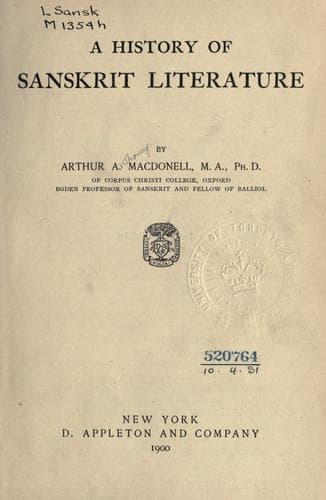
A History of Sanskrit LiteratureMacdonell, Arthur Anthony
History
A History of Sanskrit Literature
Macdonell, Arthur Anthony
Sanskrit literature -- History and criticism
The short episode which relates the origin of the çloka metre is one
of the most attractive and poetical. Valmiki in his forest hermitage
is preparing to describe worthily the fortunes of Rama. While he
is watching a fond pair of birds on the bank of the river, the
male is suddenly shot by a hunter, and falls dead on the ground,
weltering in his blood. Valmiki, deeply touched by the grief of
the bereaved female, involuntarily utters words lamenting the death
of her mate and threatening vengeance on the wicked murderer. But,
strange to tell, his utterance is no ordinary speech and flows in a
melodious stream. As he wanders, lost in thought, towards his hut,
Brahma appears and announces to the poet that he has unconsciously
created the rhythm of the çloka metre. The deity then bids him compose
in this measure the divine poem on the life and deeds of Rama. This
story may have a historical significance, for it indicates with some
probability that the classical form of the çloka was first fixed by
Valmiki, the author of the original part of the Ramayana.
The epic contains the following verse foretelling its everlasting
fame:--
As long as mountain ranges stand
And rivers flow upon the earth:
So long will this Ramayana
Survive upon the lips of men.
This prophecy has been perhaps even more abundantly fulfilled than the
well-known prediction of Horace. No product of Sanskrit literature
has enjoyed a greater popularity in India down to the present day
than the Ramayana. Its story furnishes the subject of many other
Sanskrit poems as well as plays, and still delights, from the lips
of reciters, the hearts of myriads of the Indian people, as at the
great annual Rama festival held at Benares. It has been translated
into many Indian vernaculars. Above all, it inspired the greatest poet
of mediæval Hindustan, Tulsi Das, to compose in Hindi his version of
the epic entitled Ram Charit Manas, which, with its ideal standard
of virtue and purity, is a kind of bible to a hundred millions of
the people of Northern India.
CHAPTER XI
KAVYA OR COURT EPIC
(Circa 200 B.C.-1100 A.D.)
Public-domain text, read in full here on John Shaqi.
Reviews
Reviews
No reviews yet
Be the first to share your thoughts on this work.
Elsewhere in the archive
Join the Discussion
Join the discussion
Sign in to leave a comment or review.
Sign InorCreate an account