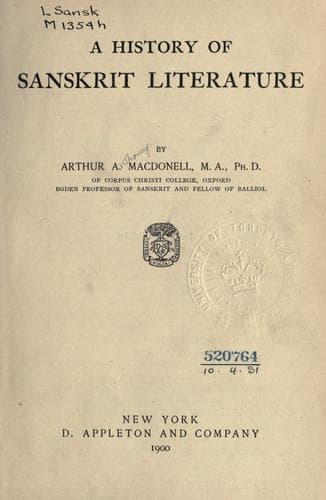
A History of Sanskrit LiteratureMacdonell, Arthur Anthony
History
A History of Sanskrit Literature
Macdonell, Arthur Anthony
Sanskrit literature -- History and criticism
The real history of the Kavya, or artificial epic poetry of India,
does not begin till the first half of the seventh century A.D.,
with the reign of King Harsha-vardhana of Thaneçar and Kanauj
(606-648), who ruled over the whole of Northern India, and under
whose patronage Bana wrote his historical romance, Harsha-charita,
and other works. The date of no Kavya before this landmark has as yet
been fixed with certainty. One work, however, which is dominated by
the Kavya style, the Brihatsamhita of the astronomer Varahamihira, can
without hesitation be assigned to the middle of the sixth century. But
as to the date of the most famous classical poets, Kalidasa, Subandhu,
Bharavi, Gunadhya, and others, we have no historical authority. The
most definite statement that can be made about them is that their fame
was widely diffused by about 600 A.D., as is attested by the way in
which their names are mentioned in Bana and in an inscription of 634
A.D. Some of them, moreover, like Gunadhya, to whose work Subandhu
repeatedly alludes, must certainly belong to a much earlier time. The
scanty materials supplied by the poets themselves, which might help to
determine their dates, are difficult to utilise, because the history
of India, both political and social, during the first five centuries
of our era, is still involved in obscurity.
With regard to the age of court poetry in general, we have
the important literary evidence of the quotations in Patanjali's
Mahabhashya, which show that Kavya flourished in his day, and must have
been developed before the beginning of our era. Several of these quoted
verses are composed in the artificial metres of the classical poetry,
while the heroic anushtubh çlokas agree in matter as well as form,
not with the popular, but with the court epics.
We further know that Açvaghosha's Buddha-charita, or "Doings of
Buddha," was translated into Chinese between 414 and 421 A.D. This
work not only calls itself a mahakavya, or "great court epic," but
is actually written in the Kavya style. Açvaghosha was, according to
the Buddhist tradition, a contemporary of King Kanishka, and would
thus belong to the first century A.D. In any case, it is evident that
his poem could not have been composed later than between 350 and 400
A.D. The mere fact, too, that a Buddhist monk thus early conceived
the plan of writing the legend of Buddha according to the rules of the
classical Sanskrit epic shows how popular the Brahmanical artificial
poetry must have become, at any rate by the fourth century A.D.,
and probably long before.
Public-domain text, read in full here on John Shaqi.
Reviews
Reviews
No reviews yet
Be the first to share your thoughts on this work.
Elsewhere in the archive
Join the Discussion
Join the discussion
Sign in to leave a comment or review.
Sign InorCreate an account