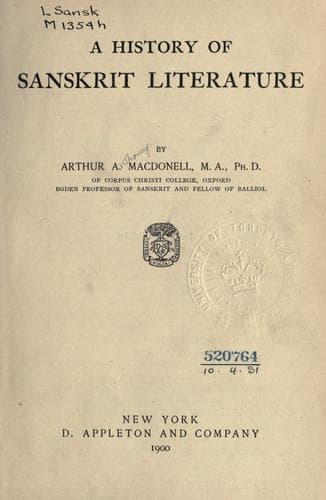
A History of Sanskrit LiteratureMacdonell, Arthur Anthony
History
A History of Sanskrit Literature
Macdonell, Arthur Anthony
Sanskrit literature -- History and criticism
The progress of epigraphic research during the last quarter of a
century has begun to shed considerable light on the history of court
poetry during the dark age embracing the first five centuries of our
era. Mr. Fleet's third volume of the Corpus Inscriptionum Indicarum
contains no fewer than eighteen inscriptions of importance in this
respect. These are written mostly in verse, but partly also in elevated
prose. They cover a period of two centuries, from about 350 to 550
A.D. Most of them employ the Gupta era, beginning A.D. 319, and first
used by Chandragupta II., named Vikramaditya, whose inscriptions and
coins range from A.D. 400 to 413. A few of them employ the Malava era,
the earlier name of the Vikrama era, which dates from 57 B.C. Several
of these inscriptions are praçastis or panegyrics on kings. An
examination of them proves that the poetical style prevailing in
the fourth, fifth, and sixth centuries did not differ from that
of the classical Kavyas which have been preserved. Samudragupta,
the second of the Gupta line, who belongs to the second half of the
fourth century, was, we learn, himself a poet, as well as a supporter
of poets. Among the latter was at least one, by name Harishena, who in
his panegyric on his royal patron, which consists of some thirty lines
(nine stanzas) of poetry and about an equal number of lines of prose,
shows a mastery of style rivalling that of Kalidasa and Dandin. In
agreement with the rule of all the Sanskrit treatises on poetics, his
prose is full of inordinately long compounds, one of them containing
more than 120 syllables. In his poetry he, like Kalidasa and others,
follows the Vidarbha style, in which the avoidance of long compounds
is a leading characteristic. In this style, which must have been fully
developed by A.D. 300, is also written an inscription by Virasena,
the minister of Chandragupta II., Samudragupta's successor.
A very important inscription dates from the year 529 of the Malava
(Vikrama) era, or A.D. 473. It consists of a poem of no fewer than
forty-four stanzas (containing 150 metrical lines), composed by a
poet named Vatsabhatti, to commemorate the consecration of a temple
of the sun at Daçapura (now Mandasor). A detailed examination of this
inscription not only leads to the conclusion that in the fifth century
a rich Kavya literature must have existed, but in particular shows that
the poem has several affinities with Kalidasa's writings. The latter
fact renders it probable that Vatsabhatti, a man of inferior poetic
talent, who professes to have produced his work with effort, knew and
utilised the poems of Kalidasa. The reign of Chandragupta Vikramaditya
II., at the beginning of the fifth century A.D., therefore seems in the
meantime the most probable approximate date for India's greatest poet.
Public-domain text, read in full here on John Shaqi.
Reviews
Reviews
No reviews yet
Be the first to share your thoughts on this work.
Elsewhere in the archive
Join the Discussion
Join the discussion
Sign in to leave a comment or review.
Sign InorCreate an account