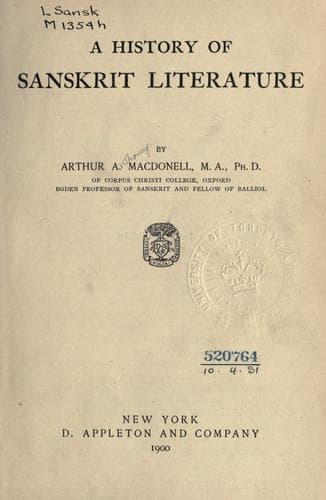
A History of Sanskrit LiteratureMacdonell, Arthur Anthony
History
A History of Sanskrit Literature
Macdonell, Arthur Anthony
Sanskrit literature -- History and criticism
Another late epic, narrating the fortunes of the same hero as the
Naishadhiya, is the Nalodaya, or "Rise of Nala," which describes the
restoration to power of King Nala after he had lost his all. Though
attributed to Kalidasa, it is unmistakably the product of a much
later age. The chief aim of the author is to show off his skill
in the manipulation of the most varied and artificial metres, as
well as all the elaborate tricks of style exhibited in the latest
Kavyas. Rhyme even is introduced, and that, too, not only at the
end of, but within metrical lines. The really epic material is but
scantily treated, narrative making way for long descriptions and
lyrical effusions. Thus the second and longest of the four cantos
of the poem is purely lyrical, describing only the bliss of the
newly-wedded pair, with all kinds of irrelevant additions.
The culmination of artificiality is attained by the Raghava-pandaviya,
a poem composed by Kaviraja, who perhaps flourished about A.D. 800. It
celebrates simultaneously the actions of Raghava or Rama and of
the Pandava princes. The composition is so arranged that by the
use of ambiguous words and phrases the story of the Ramayana and
the Mahabharata is told at one and the same time. The same words,
according to the sense in which they are understood, narrate the events
of each epic. A tour de force of this kind is doubtless unique in the
literatures of the world. Kaviraja has, however, found imitators in
India itself.
A Mahakavya which is as yet only known in MS. is the
Navasahasanka-charita, a poem celebrating the doings of Navasahasanka,
otherwise Sindhuraja, a king of Malava, and composed by a poet named
Padmagupta, who lived about 1000 A.D. It consists of eighteen cantos,
containing over 1500 stanzas in nineteen different metres. The poet
refrains from the employment of metrical tricks; but he greatly
impedes the progress of the narrative by introducing interminable
speeches and long-winded descriptions.
We may mention, in conclusion, that there is also an epic in Prakrit
which is attributed to Kalidasa. This is the Setu-bandha, "Building
of the Bridge," or Ravanavadha, "Death of Ravana," which relates
the story of Rama. It is supposed to have been composed by the poet
to commemorate the building of a bridge of boats across the Vitasta
(Jhelum) by King Pravarasena of Kashmir.
Public-domain text, read in full here on John Shaqi.
Reviews
Reviews
No reviews yet
Be the first to share your thoughts on this work.
Elsewhere in the archive
Join the Discussion
Join the discussion
Sign in to leave a comment or review.
Sign InorCreate an account