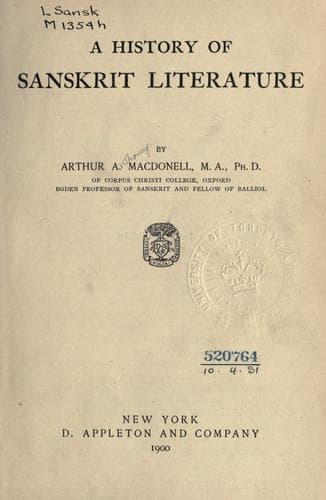
A History of Sanskrit LiteratureMacdonell, Arthur Anthony
History
A History of Sanskrit Literature
Macdonell, Arthur Anthony
Sanskrit literature -- History and criticism
There are a few prose romances dating from the sixth and seventh
centuries, which being classed as Kavyas by the Sanskrit writers
on poetics, may be mentioned in this place. The abundant use of
immense compounds, which of course makes them very difficult reading,
is an essential characteristic of the style of these works. As to
their matter, they contain but little action, consisting largely of
scenes which are strung together by a meagre thread of narrative, and
are made the occasion of lengthy descriptions full of long strings
of comparisons and often teeming with puns. In spite, however, of
their highly artificial and involved style, many really poetical
thoughts may be found embedded in what to the European taste is an
unattractive setting.
The Daça-kumara-charita, or "Adventures of the Ten Princes," contains
stories of common life and reflects a corrupt state of society. It is
by Dandin, and probably dates from the sixth century A.D. Vasavadatta,
by Subandhu, relates the popular story of the heroine Vasavadatta,
princess of Ujjayini, and Udayana, king of Vatsa. It was probably
written quite at the beginning of the seventh century. Slightly
later is Bana's Kadambari, a poetical romance narrating the fortunes
of a princess of that name. Another work of a somewhat similar
character by the same author is the Harsha-charita, a romance in
eight chapters, in which Bana attempts to give some account of the
life of King Harshavardhana of Kanauj. There is, however, but little
narrative. Thus in twenty-five pages of the eighth chapter there are
to be found five long descriptions, extending on the average to two
pages, to say nothing of shorter ones. There is, for instance, a long
disquisition, covering four pages, and full of strings of comparisons,
about the miseries of servitude. A servant, "like a painted bow,
is for ever bent in the one act of distending a string of imaginary
virtues, but there is no force in him; like a heap of dust-sweepings
gathered by a broom, he carries off toilet-leavings; like the meal
offered to the Divine Mothers, he is cast out into space even at night;
like a pumping machine, he has left all weight behind him and bends
even for water," and so on. Soon after comes a description, covering
two pages, of the trees in a forest. This is immediately followed by
another page enumerating the various kinds of students thronging the
wood in order to avail themselves of the teaching of a great Buddhist
sage; they even include monkeys busily engaged in ritual ceremonies,
devout parrots expounding a Buddhist dictionary, owls lecturing on
the various births of Buddha, and tigers who have given up eating
flesh under the calming influence of Buddhist teaching. Next comes
a page describing the sage himself. "He was clad in a very soft
red cloth, as if he were the eastern quarter of the sky bathed in
the morning sunshine, teaching the other quarters to assume the red
Buddhist attire, while they were flushed with the pure red glow of
Public-domain text, read in full here on John Shaqi.
Reviews
Reviews
No reviews yet
Be the first to share your thoughts on this work.
Elsewhere in the archive
Join the Discussion
Join the discussion
Sign in to leave a comment or review.
Sign InorCreate an account