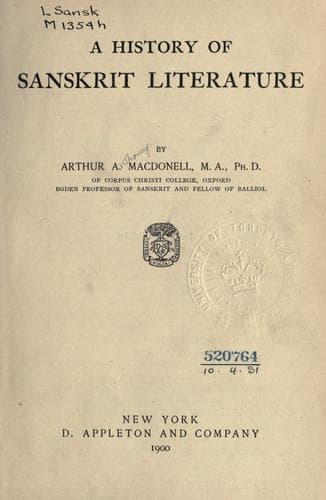
A History of Sanskrit LiteratureMacdonell, Arthur Anthony
History
A History of Sanskrit Literature
Macdonell, Arthur Anthony
Sanskrit literature -- History and criticism
In the second half of the poem the Yaksha first describes the beauties
of this city and his own dwelling there. Going on to paint in glowing
colours the charms of his wife, her surroundings, and her occupations,
he imagines her tossing on her couch, sleepless and emaciated, through
the watches of the night. Then, when her eye rests on the window, the
cloud shall proclaim to her with thunder-sound her husband's message,
that he is still alive and ever longs to behold her:--
In creepers I discern thy form, in eyes of startled hinds thy
glances,
And in the moon thy lovely face, in peacocks' plumes thy shining
tresses;
The sportive frown upon thy brow in flowing waters' tiny ripples:
But never in one place combined can I, alas! behold thy likeness.
But courage, he says; our sorrow will end at last--we shall be
re-united--
And then we will our hearts' desire, grown more intense by
separation,
Enjoy in nights all glorious and bright, with full-orbed autumn
moonlight.
Then begging the cloud, after delivering his message, to return with
reassuring news, the exile finally dismisses him with the hope that
he may never, even for a moment, be divided from his lightning spouse.
Besides the expression of emotion, the descriptive element is very
prominent in this fine poem. This is still more true of Kalidasa's
Ritusamhara, or "Cycle of the Seasons." That little work, which
consists of 153 stanzas in six cantos, and is composed in various
metres, is a highly poetical description of the six seasons into which
classical Sanskrit poets usually divide the Indian year. With glowing
descriptions of the beauties of Nature, in which erotic scenes are
interspersed, the poet adroitly interweaves the expression of human
emotions. Perhaps no other work of Kalidasa's manifests so strikingly
the poet's deep sympathy with Nature, his keen powers of observation,
and his skill in depicting an Indian landscape in vivid colours.
The poem opens with an account of summer. If the glow of the sun is
then too great during the day, the moonlit nights are all the more
delightful to lovers. The moon, beholding the face of beauteous
maidens, is beside itself with jealousy; then, too, it is that the
heart of the wanderer is burnt by the fire of separation. Next follows
a brilliant description of the effects of the heat: the thirst or
lethargy it produces in serpent, lion, elephant, buffalo, boar,
gazelle, peacock, crane, frogs, and fishes; the devastation caused
by the forest fire which devours trees and shrubs, and drives before
it crowds of terror-stricken beasts.
Public-domain text, read in full here on John Shaqi.
Reviews
Reviews
No reviews yet
Be the first to share your thoughts on this work.
Elsewhere in the archive
Join the Discussion
Join the discussion
Sign in to leave a comment or review.
Sign InorCreate an account