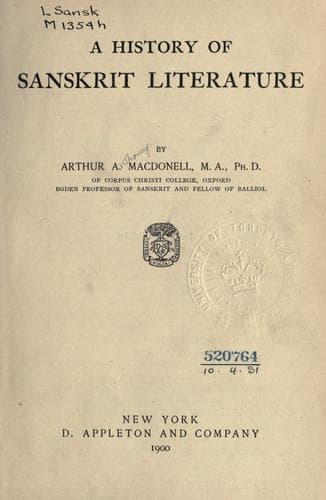
A History of Sanskrit LiteratureMacdonell, Arthur Anthony
History
A History of Sanskrit Literature
Macdonell, Arthur Anthony
Sanskrit literature -- History and criticism
The close heat is succeeded by the rains, which are announced by
the approach of the dark heavy clouds with their banner of lightning
and drum of thunder. Slowly they move accompanied by chataka birds,
fabled to live exclusively on raindrops, till at length they discharge
their water. The wild streams, like wanton girls, grasp in a trice
the tottering trees upon their banks, as they rush onwards to the
sea. The earth becomes covered with young blades of grass, and the
forests clothe themselves with golden buds--
The mountains fill the soul with yearning thoughts of love,
When rain-charged clouds bend down to kiss the tow'ring rocks,
When all around upon their slopes the streams gush down,
And throngs of peacocks that begin to dance are seen.
Next comes the autumn, beauteous as a newly-wedded bride, with face
of full-blown lotuses, with robe of sugarcane and ripening rice, with
the cry of flamingoes representing the tinkling of her anklets. The
graceful creepers vie with the arms of lovely women, and the jasmine,
showing through the crimson açoka blossoms, rivals the dazzling teeth
and red lips of smiling maidens.
Winter follows, when the rice ripens, while the lotus fades and the
fields in the morning are covered with rime--
Then the Priyangu creeper, reaching ripeness,
Buffeted constantly by chilling breezes,
Grows, O Beloved, ever pale and paler,
Like lonely maiden from her lover parted.
This is the time dear to lovers, whose joys the poet describes in
glowing colours.
In the cold season a fire and the mild rays of the sun are
pleasant. The night does not attract lovers now, for the moonbeams
are cold and the light of the stars is pale.
The poet dwells longest on the delights of spring, the last of the
six seasons. It is then that maidens, with karnikara flowers on their
ears, with red açoka blossoms and sprays of jasmine in their locks,
go to meet their lovers. Then the hum of intoxicated bees is heard,
and the note of the Indian cuckoo; then the blossoms of the mango-tree
are seen: these are the sharp arrows wherewith the god of the flowery
bow enflames the hearts of maidens to love.
A lyric poem of a very artificial character, and consisting of only
twenty-two stanzas, is the Ghata-karpara, or "Potsherd," called after
the author's name, which is worked into the last verse. The date of
the poet is unknown. He is mentioned as one of the "nine gems" at
the court of the mythical Vikramaditya in the verse already mentioned.
Public-domain text, read in full here on John Shaqi.
Reviews
Reviews
No reviews yet
Be the first to share your thoughts on this work.
Elsewhere in the archive
Join the Discussion
Join the discussion
Sign in to leave a comment or review.
Sign InorCreate an account