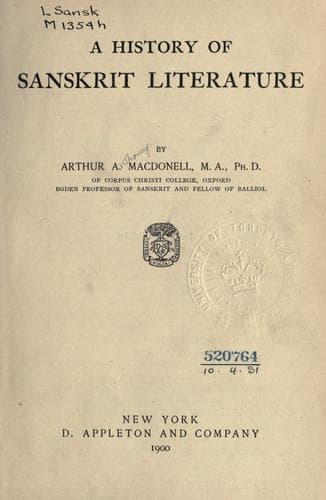
A History of Sanskrit LiteratureMacdonell, Arthur Anthony
History
A History of Sanskrit Literature
Macdonell, Arthur Anthony
Sanskrit literature -- History and criticism
The transitional stage between pure lyric and pure drama is represented
by the Gitagovinda, or "Cowherd in Song," a lyrical drama, which,
though dating from the twelfth century, is the earliest literary
specimen of a primitive type of play that still survives in Bengal,
and must have preceded the regular dramas. The poem contains no
dialogue in the proper sense, for its three characters only engage
in a kind of lyrical monologue, of which one of the other two is
supposed to be an auditor, sometimes even no one at all. The subject
of the poem is the love of Krishna for the beautiful cowherdess Radha,
the estrangement of the lovers, and their final reconciliation. It is
taken from that episode of Krishna's life in which he himself was a
herdsman (go-vinda), living on the banks of the Yamuna, and enjoying
to the full the love of the cowherdesses. The only three characters
of the poem are Krishna, Radha, and a confidante of the latter.
Its author, Jayadeva, was probably a native of Bengal, having been
a contemporary of a Bengal king named Lakshmanasena. It is probable
that he took as his model popular plays representing incidents from
the life of Krishna, as the modern yatras in Bengal still do. The
latter festival plays even now consist chiefly of lyrical stanzas,
partly recited and partly sung, the dialogue being but scanty, and to
a considerable extent left to improvisation. On such a basis Jayadeva
created his highly artificial poem. The great perfection of form he
has here attained, by combining grace of diction with ease in handling
the most difficult metres, has not failed to win the admiration of
all who are capable of reading the original Sanskrit. Making abundant
use of alliteration and the most complex rhymes occurring, as in the
Nalodaya, not only at the end, but in the middle of metrical lines,
[13] the poet has adapted the most varied and melodious measures
to the expression of exuberant erotic emotions, with a skill which
could not be surpassed. It seems impossible to reproduce Jayadeva's
verse adequately in an English garb. The German poet Rückert, has,
however, come as near to the highly artificial beauty of the original,
both in form and matter, as is feasible in any translation.
It is somewhat strange that a poem which describes the transports of
sensual love with all the exuberance of an Oriental fancy should,
in the present instance, and not for the first time, have received
an allegorical explanation in a mystical religious sense. According
to Indian interpreters, the separation of Krishna and Radha, their
seeking for each other, and their final reconciliation represent the
relation of the supreme deity to the human soul. This may possibly
have been the intention of Jayadeva, though only as a leading idea,
not to be followed out in detail.
CHAPTER XIII
THE DRAMA
(Circa 400-1000 A.D.)
Public-domain text, read in full here on John Shaqi.
Reviews
Reviews
No reviews yet
Be the first to share your thoughts on this work.
Elsewhere in the archive
Join the Discussion
Join the discussion
Sign in to leave a comment or review.
Sign InorCreate an account