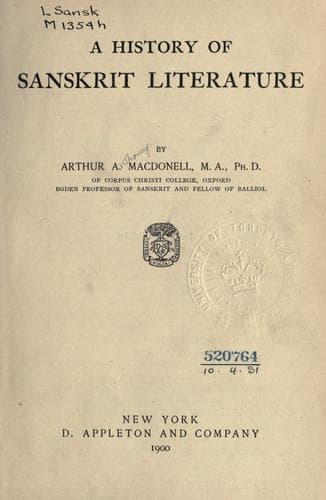
A History of Sanskrit LiteratureMacdonell, Arthur Anthony
History
A History of Sanskrit Literature
Macdonell, Arthur Anthony
Sanskrit literature -- History and criticism
Many lyrical gems are to be found preserved in the Sanskrit treatises
on poetics. One such is a stanza on the red açoka. In this the poet
asks the tree to say whither his mistress has gone; it need not shake
its head in the wind, as if to say it did not know; for how could it
be flowering so brilliantly had it not been touched by the foot of
his beloved? [12]
In all this lyrical poetry the plant and animal world plays an
important part and is treated with much charm. Of flowers, the lotus
is the most conspicuous. One of these stanzas, for example, describes
the day-lotuses as closing their calyx-eyes in the evening, because
unwilling to see the sun, their spouse and benefactor, sink down bereft
of his rays. Another describes with pathetic beauty the dream of a bee:
"The night will pass, the fair dawn will come, the sun will rise,
the lotuses will laugh;" while a bee thus mused within the calyx,
an elephant, alas! tore up the lotus plant.
Various birds to which poetical myths are attached are frequently
introduced as furnishing analogies to human life and love. The chataka,
which would rather die of thirst than drink aught but the raindrops
from the cloud, affords an illustration of pride. The chakora,
supposed to imbibe the rays of the moon, affords a parallel to the
lover who with his eyes drinks in the beams of his beloved's face. The
chakravaka, which, fabled to be condemned to nocturnal separation
from his mate, calls to her with plaintive cry during the watches of
the night, serves as an emblem of conjugal fidelity.
In all this lyric poetry the bright eyes and beauty of Indian girls
find a setting in scenes brilliant with blossoming trees, fragrant
with flowers, gay with the plumage and vocal with the song of birds,
diversified with lotus ponds steeped in tropical sunshine and with
large-eyed gazelles reclining in the shade. Some of its gems are well
worthy of having inspired the genius of Heine to produce such lyrics
as Die Lotosblume and Auf Flügeln des Gesanges.
A considerable amount of lyrical poetry of the same type has also been
produced in Prakrit, especially in the extensive anthology entitled
Saptaçataka, or "Seven Centuries," of the poet Hala, who probably
lived before A.D. 1000. It contains many beauties, and is altogether a
rich treasury of popular Indian lyrical poetry. It must suffice here
to refer to but one of the stanzas contained in this collection. In
this little poem the moon is described as a white swan sailing on
the pure nocturnal lake of the heavens, studded with starry lotuses.
Public-domain text, read in full here on John Shaqi.
Reviews
Reviews
No reviews yet
Be the first to share your thoughts on this work.
Elsewhere in the archive
Join the Discussion
Join the discussion
Sign in to leave a comment or review.
Sign InorCreate an account