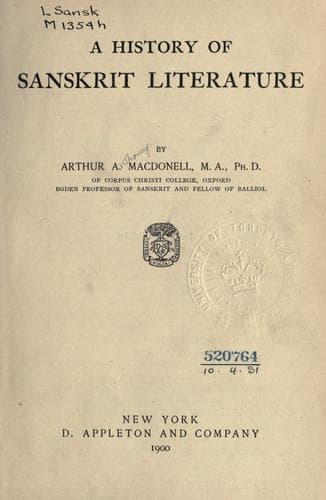
A History of Sanskrit LiteratureMacdonell, Arthur Anthony
History
A History of Sanskrit Literature
Macdonell, Arthur Anthony
Sanskrit literature -- History and criticism
Every Sanskrit play begins with a prologue or introduction, which
regularly opens with a prayer or benediction (nandi) invoking the
national deity in favour of the audience. Then generally follows a
dialogue between the stage-manager and one or two actors, which refers
to the play and its author, seeks to win public favour by paying
a complimentary tribute to the critical acumen of the spectators,
mentions past events and present circumstances elucidating the plot,
and invariably ends by adroitly introducing one of the characters of
the actual play. A Sanskrit drama is divided into scenes and acts. The
former are marked by the entrance of one character and the exit of
another. The stage is never left vacant till the end of the act,
nor does any change of locality take place till then. Before a new
act an interlude (called vishkambha or praveçaka), consisting of a
monologue or dialogue, is often introduced. In this scene allusion
is made to events supposed to have occurred in the interval, and the
audience are prepared for what is about to take place. The whole piece
closes with a prayer for national prosperity, which is addressed to
the favourite deity and is spoken by one of the principal characters.
The number of acts in a play varies from one to ten; but, while
fluctuating somewhat, is determined by the character of the drama. Thus
the species called natika has four acts and the farcical prahasana
only one.
The duration of the events is supposed to be identical with the
time occupied in performing them on the stage, or, at most, a day;
and a night is assumed to elapse between each act and that which
follows. Occasionally, however, the interval is much longer. Thus in
Kalidasa's Çakuntala and Urvaçi several years pass between the first
and the last act; while in Bhavabhuti's Uttara-ramacharita no less
than twelve years elapse between the first and the second act.
Nor is unity of place observed; for the scene may be transferred from
one part of the earth to another, or even to the aërial regions. Change
of locality sometimes occurs even within the same act; as when a
journey is supposed to be performed through the air in a celestial
car. It is somewhat curious that while there are many and minute
stage directions about dress and decorations no less than about the
actions of the players, nothing is said in this way as to change
of scene. As regards the number of characters appearing in a play,
no limit of any kind is imposed.
Public-domain text, read in full here on John Shaqi.
Reviews
Reviews
No reviews yet
Be the first to share your thoughts on this work.
Elsewhere in the archive
Join the Discussion
Join the discussion
Sign in to leave a comment or review.
Sign InorCreate an account