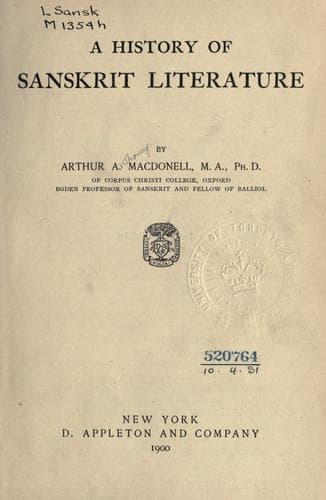
A History of Sanskrit LiteratureMacdonell, Arthur Anthony
History
A History of Sanskrit Literature
Macdonell, Arthur Anthony
Sanskrit literature -- History and criticism
There were no special theatres in the Indian Middle Ages, and plays
seem to have been performed in the concert-room (samgita-çala) of royal
palaces. A curtain divided in the middle was a necessary part of the
stage arrangement; it did not, however, separate the audience from
the stage, as in the Roman theatre, but formed the background of the
stage. Behind the curtain was the tiring-room (nepathya), whence the
actors came on the stage. When they were intended to enter hurriedly,
they were directed to do so "with a toss of the curtain." The stage
scenery and decorations were of a very simple order, much being
left to the imagination of the spectator, as in the Shakespearean
drama. Weapons, seats, thrones, and chariots appeared on the stage;
but it is highly improbable that the latter were drawn by the living
animals supposed to be attached to them. Owing to the very frequent
intercourse between the inhabitants of heaven and earth, there may
have been some kind of aërial contrivance to represent celestial
chariots; but owing to the repeated occurrence of the stage direction
"gesticulating" (natayitva) in this connection, it is to be supposed
that the impression of motion and speed was produced on the audience
simply by the gestures of the actors.
The best productions of the Indian drama are nearly a dozen in number,
and date from a period embracing something like four hundred years,
from about the beginning of the fifth to the end of the eighth century
A.D. These plays are the compositions of the great dramatists Kalidasa
and Bhavabhuti, or have come down under the names of the royal patrons
Çudraka and Çriharsha, to whom their real authors attributed them.
The greatest of all is Kalidasa, already known to us as the author of
several of the best Kavyas. Three of his plays have been preserved,
Çakuntala, Vikramorvaçi, and Malavikagnimitra. The richness of creative
fancy which he displays in these, and his skill in the expression
of tender feeling, assign him a high place among the dramatists of
the world. The harmony of the poetic sentiment is nowhere disturbed
by anything violent or terrifying. Every passion is softened without
being enfeebled. The ardour of love never goes beyond æsthetic bounds;
it never maddens to wild jealousy or hate. The torments of sorrow
are toned down to a profound and touching melancholy. It was here at
last that the Indian genius found the law of moderation in poetry,
which it hardly knew elsewhere, and thus produced works of enduring
beauty. Hence it was that Çakuntala exercised so great a fascination
on the calm intellect of Goethe, who at the same time was so strongly
repelled by the extravagances of Hindu mythological art.
Public-domain text, read in full here on John Shaqi.
Reviews
Reviews
No reviews yet
Be the first to share your thoughts on this work.
Elsewhere in the archive
Join the Discussion
Join the discussion
Sign in to leave a comment or review.
Sign InorCreate an account