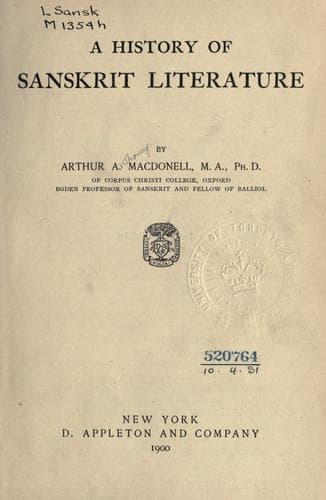
A History of Sanskrit LiteratureMacdonell, Arthur Anthony
History
A History of Sanskrit Literature
Macdonell, Arthur Anthony
Sanskrit literature -- History and criticism
In the second act the comic element is introduced with the jester
Mathavya, who is as much disgusted with his master's love-lorn
condition as with his fondness for the chase. In the third act,
the love-sick Çakuntala is discovered lying on a bed of flowers in
an arbour. The king overhears her conversation with her two friends,
shows himself, and offers to wed the heroine. An interlude explains
how a choleric ascetic, named Durvasa, enraged at not being greeted
by Çakuntala with due courtesy, owing to her pre-occupied state, had
pronounced a curse which should cause her to be entirely forgotten
by her lover, who could recognise her only by means of a ring.
The king having meanwhile married Çakuntala and returned home,
the sage Kanva has resolved to send her to her husband. The way in
which Çakuntala takes leave of the sacred grove in which she has
been brought up, of her flowers, her gazelles, and her friends,
is charmingly described in the fourth act. This is the act which
contains the most obvious beauties; for here the poet displays to the
full the richness of his fancy, his abundant sympathy with Nature,
and a profound knowledge of the human heart.
A young Brahman pupil thus describes the dawning of the day on which
Çakuntala is to leave the forest hermitage--
On yonder side the moon, the Lord of Plants,
Sinks down behind the western mountain's crest;
On this, the sun preceded by the dawn
Appears: the setting and the rise at once
Of these two orbs the symbols are of man's
Own fluctuating fortunes in the world.
Then he continues--
The moon has gone; the lilies on the lake,
Whose beauty lingers in the memory,
No more delight my gaze: they droop and fade;
Deep is their sorrow for their absent lord.
The aged hermit of the grove thus expresses his feelings at the
approaching loss of Çakuntala--
My heart is touched with sadness at the thought
"Çakuntala must go to-day"; my throat
Is choked with flow of tears repressed; my sight
Is dimmed with pensiveness; but if the grief
Of an old forest hermit is so great,
How keen must be the pang a father feels
When freshly parted from a cherished child!
Then calling on the trees to give her a kindly farewell, he exclaims--
The trees, the kinsmen of her forest home,
Now to Çakuntala give leave to go:
They with the Kokila's melodious cry
Their answer make.
Thereupon the following good wishes are uttered by voices in the air--
Thy journey be auspicious; may the breeze,
Gentle and soothing, fan thy cheek; may lakes
All bright with lily cups delight thine eye;
The sunbeams' heat be cooled by shady trees;
The dust beneath thy feet the pollen be
Of lotuses.
Public-domain text, read in full here on John Shaqi.
Reviews
Reviews
No reviews yet
Be the first to share your thoughts on this work.
Elsewhere in the archive
Join the Discussion
Join the discussion
Sign in to leave a comment or review.
Sign InorCreate an account