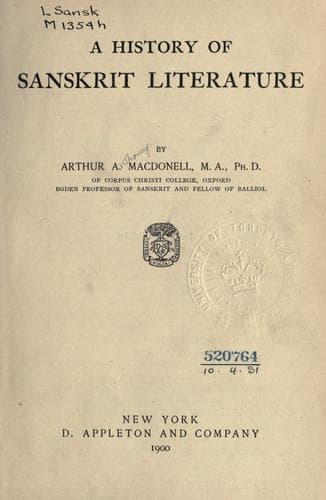
A History of Sanskrit LiteratureMacdonell, Arthur Anthony
History
A History of Sanskrit Literature
Macdonell, Arthur Anthony
Sanskrit literature -- History and criticism
In comparison with the Greek and the modern drama, Nature occupies
a much more important place in Sanskrit plays. The characters are
surrounded by Nature, with which they are in constant communion. The
mango and other trees, creepers, lotuses, and pale-red trumpet-flowers,
gazelles, flamingoes, bright-hued parrots, and Indian cuckoos, in
the midst of which they move, are often addressed by them and form an
essential part of their lives. Hence the influence of Nature on the
minds of lovers is much dwelt on. Prominent everywhere in classical
Sanskrit poetry, these elements of Nature luxuriate most of all in
the drama.
The finest of Kalidasa's works are, it cannot be denied, defective
as stage-plays. The very delicacy of the sentiment, combined with
a certain want of action, renders them incapable of producing a
powerful effect on an audience. The best representatives of the
romantic drama of India are Çakuntala and Vikramorvaçi. Dealing
with the love adventures of two famous kings of ancient epic legend,
they represent scenes far removed from reality, in which heaven and
earth are not separated, and men, demigods, nymphs, and saints are
intermingled. Malavikagnimitra, on the other hand, not concerned
with the heroic or divine, is a palace-and-harem drama, a story of
contemporary love and intrigue.
The plot of Çakuntala is derived from the first book of the
Mahabharata. The hero is Dushyanta, a celebrated king of ancient
days, the heroine, Çakuntala, the daughter of a celestial nymph,
Menaka, and of the sage Viçvamitra; while their son, Bharata, became
the founder of a famous race. The piece consists of seven acts, and
belongs to the class of drama by native writers on poetics styled
nataka, or "the play." In this the plot must be taken from mythology
or history, the characters must be heroic or divine; it should be
written in elaborate style, and full of noble sentiments, with five
acts at least, and not more than ten.
After the prelude, in which an actress sings a charming lyric on the
beauties of summer-time, King Dushyanta appears pursuing a gazelle in
the sacred grove of the sage Kanva. Here he catches sight of Çakuntala,
who, accompanied by her two maiden friends, is engaged in watering
her favourite trees. Struck by her beauty, he exclaims--
Her lip is ruddy as an opening bud.
Her graceful arms resemble tender shoots:
Attractive as the bloom upon the tree,
The glow of youth is spread on all her limbs.
Seizing an opportunity of addressing her, he soon feels that it is
impossible for him to return to his capital--
My limbs move forward, while my heart flies back,
Like silken standard borne against the breeze.
Public-domain text, read in full here on John Shaqi.
Reviews
Reviews
No reviews yet
Be the first to share your thoughts on this work.
Elsewhere in the archive
Join the Discussion
Join the discussion
Sign in to leave a comment or review.
Sign InorCreate an account