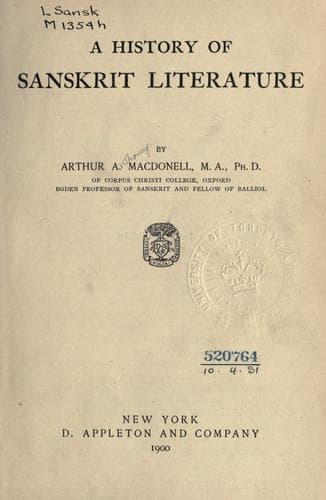
A History of Sanskrit LiteratureMacdonell, Arthur Anthony
History
A History of Sanskrit Literature
Macdonell, Arthur Anthony
Sanskrit literature -- History and criticism
The fourth act is peculiar in being almost entirely lyrical. The
lovers are wandering near Kailasa, the divine mountain, when Urvaçi,
in a fit of jealousy, enters the grove of Kumara, god of war, which is
forbidden to all females. In consequence of Bharata's curse, she is
instantly transformed into a creeper. The king, beside himself with
grief at her loss, seeks her everywhere. He apostrophises various
insects, birds, beasts, and even a mountain peak, to tell him where
she is. At last he thinks he sees her in the mountain stream:--
The rippling wave is like her frown; the row
Of tossing birds her girdle; streaks of foam
Her flutt'ring garment as she speeds along;
The current, her devious and stumbling gait:
'Tis she turned in her wrath into a stream.
Finally, under the influence of a magic stone, which has come into
his possession, he clasps a creeper, which is transformed into Urvaçi
in his arms.
Between the fourth and fifth acts several years elapse. Then Pururavas,
by accident, discovers his son Ayus, whom Urvaçi had secretly borne,
and had caused to be brought up in a hermitage. Urvaçi must therefore
return to heaven. Indra, however, in return for Pururavas' services
against the demons, makes a new concession, and allows the nymph to
remain with the king for good.
There are two recensions of this play also, one of them belonging to
Southern India.
The doubts long entertained, on the ground of its inferiority and
different character, as to whether Malavikagnimitra, or "Malavika and
Agnimitra," is really the work of Kalidasa, who is mentioned in the
prologue as the author, are hardly justified. The piece has been shown
by Weber to agree pretty closely in thought and diction with the two
other plays of the poet; and though certainly not equal to the latter
in poetic merit, it possesses many beauties. The subject is not heroic
or divine, the plot being derived from the ordinary palace life of
Indian princes, and thus supplying a peculiarly good picture of the
social conditions of the times. The hero is a historical king of the
dynasty of the Çungas, who reigned at Vidiça (Bhilsa) in the second
century B.C. The play describes the loves of this king Agnimitra and
of Malavika, one of the attendants of the queen, who jealously keeps
her out of the king's sight on account of her great beauty. The various
endeavours of the king to see and converse with Malavika give rise to
numerous little intrigues. In the course of these Agnimitra nowhere
appears as a despot, but acts with much delicate consideration for
the feelings of his spouses. It finally turns out that Malavika is by
birth a princess, who had only come to be an attendant at Agnimitra's
court through having fallen into the hands of robbers. There being
now no objection to her union with the king, all ends happily.
Public-domain text, read in full here on John Shaqi.
Reviews
Reviews
No reviews yet
Be the first to share your thoughts on this work.
Elsewhere in the archive
Join the Discussion
Join the discussion
Sign in to leave a comment or review.
Sign InorCreate an account